Introduction
We’re presently in a full-blown crisis of democracy that happens to coincide with the escalating climate crisis. I started organizing to raise climate consciousness in my area in the summer of 2023 with the objective of achieving the goal of Rupert Read’s Climate Majority Project which is to activate the actual majority of people who are concerned about climate change. Read adopted this position after his Extinction Rebellion failed to move elected officials to take sufficiently bold climate action. He observed that although the majority of people did support XR’s goal, they didn’t want to identify themselves or to be identified by others as activists.
Our crisis of democracy calls for a similar majority mobilization, for only about thirty-two percent of registered voters voted for Trump in the 2024 election, while over thirty-six percent of the electorate didn’t vote at all. The current Resistance is attracting old and new activists, but is on track to repeat the pattern of failing to engage the majority of the population, one of the reasons for which is that too many people decline to assume the activist identity.
Identity is a big deal. People adopt the personae conferred upon them by their work, income class, religion, ethnicity, political and organizational affiliations and, most importantly, are identified by others in these terms especially with respect to race, ethnicity and politics. Our association with other people is generally within identity groups. In 1903 German sociologist Georg Simmel observed that to counter the anomie of the metropolis people gathered into fairly homogenous groups in which over time conformity became stricter. Eric Hobsbawm wrote in 1996 that the purpose of identity groups is not to include but to exclude, and in 2008 Bill Bishop published The Big Sort describing the progressive geographical clustering of like-minded Americans.
Workplaces and volunteer organizations function mostly as one-dimensional systems in which everyone is expected to serve as part of the organization and nothing else, assuming the very narrow identity of the group. This can deter people from joining and participating in organizations or causes. As an issue and electoral organizer I have considerable first-hand experience of the phenomenon and now see urgent need for a new approach to build not only the Resistance, but to also advance bold climate action.
For the latter purpose we do need to change the political economy to bring it into line with the ecology of nature, and much work is being done with this aim, especially in the way of creating regenerative communities. Our ultimate goal is the ecological civilization composed of such communities, but people are by no means presently flocking to them. To save the planet and, most immediately our democracy, we must, as Rupert Read says, meet people where they are and we can do this by living like fungi.
Fungi
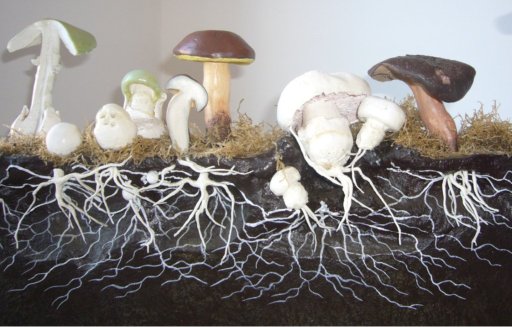
Fungi belong to a biological kingdom distinct from plants and animals with most species consisting of hyphae, individual, thread-like tubular structures that branch, interweave and intersect to form an extensive network known as mycelium. These arise from the germination of fungal spores which, upon landing on a suitable substrate, individually generate hyphae that then spread out and interconnect among themselves and with those of other individuals. Mycelium are therefore alternatively considered to be single organisms and colonies of multiple ones. The growth of mycelium occurs at the hyphae tips, and mushrooms, the fruiting bodies of fungi, are formed by the felting together of hyphal strands.
Having first appeared on earth about a billion years ago, today fungi are present everywhere in very large numbers—in the soil and the air, in lakes, rivers, and seas, on and within plants and animals, in food and clothing, and in the human body. They form vast networks in the soil, constituting 20-30% of soil biomass.
Fungi have attracted interest as key components in the “wood-wide web” introduced by Suzanne Simard in a 1997 Nature article which was followed by Peter Wohlleben’s 2018 The Hidden Life of Trees, Merlin Sheldrake’s 2020 Entangled Life: How Fungi Make Our Worlds, Change Our Minds and Shape Our Futures and Simard’s 2021 Finding the Mother Tree: Discovering the Wisdom of the Forest. Close examination of fungi reveal the ways in which they physically connect other organisms with each other in natural communities, transmit water and nutrients, communicate information between them, form reciprocal nourishing relationships, literally bond with them to bring about mutual metabolic change and even form distinct composite organisms. Some of the behavior of fungi is so remarkable that researchers are tempted to call it intelligent.
From the soil fungi absorb nitrogen, water and minerals including phosphorus. They decompose organic material and, unlike plants and animals that take in substances that they then metabolize, fungi digest materials first, then absorb them into their bodies. Hyphae secrete enzymes that break down complex molecules in the environment, following which they absorb the simpler compounds directly through their cell walls. They transmit substances to the plants among whose roots they live, notably nitrogen, which the latter cannot extract from the atmosphere, in exchange for carbon, which is similarly inaccessible to fungi that do not photosynthesize carbon dioxide.
To effect the exchange mycorrhizal fungi and roots come together and form bonds. Certain plant roots disperse volatile chemicals into the soil that accelerate spore germination and branching hyphal growth. Meanwhile fungi produce plant growth hormones that cause roots to similarly grow into feathery masses. Communicating by chemical means the fungi and plant each modify their metabolisms with processes that include the fungi chemically neutralizing the plant’s immunity to make contact and form symbiotic structures.
Fungi share their soil environment with not only the roots of trees but also those of countless other plants and astronomical numbers of bacteria, protozoa, and nematodes as well as animals such as earthworms, spiders and insects. There are billions of these organisms in just one teaspoon of healthy soil. Bacteria exist inside fungal hyphae, functioning in what are called endosymbiotic relationships, and they are also present in lichens, which unite fungi and algae into single organisms.
In the study of fungi it may not be possible to determine where one individual organism and even one kind of organism ends and another begins. In fact mycelium may be better thought of as not a thing but a process. They disperse chemicals into the soil and the air including the odor produced by truffles that attract animals who dig them up, eat them and later distribute the spores in their feces. These fields of odor are extensions of truffles’ material bodies.
Wood wide webs are dynamic systems in unceasing flux and are classified as “complex adaptive systems” because their behavior cannot be inferred from a knowledge of their constituent parts alone and they transform themselves and their behaviors in response to their circumstances.
Fungi serve as channels of communication, for example, to transmit alerts between plants. In an experiment an unaffected bean plant that shared a mycorrhizal network with one infested with aphids was moved to escalate production of volatile defense compounds. The latter in turn attracted parasitic wasps that prey on the aphids.
A study that traced carbon moving from plant roots into fungal hyphae and phosphorus moving from fungi into plant roots revealed a process of trading between the plant and the fungus. Exchange was in some sense negotiated between the two depending on the availability of resources, suggesting a supply and demand dynamic. Their behavior varied, depending on what was taking place around them and in other parts of themselves. The decision-making capacity of fungi is one manifestation of their apparent intelligence, with the other principal indication being the coordinated actions of separate hyphae. Most fungal species actively sense and respond to their surroundings principally through the chemical interactions of their hyphae. Despite being composed of a multitude of hyphae, the functioning of fungi is often unified as they transport materials and transmit signals. They can spread in all directions or, alternatively, as a single mass upon finding a patch of nutrients. In a remarkable experiment with a bioluminescent fungus, a wave of illumination rapidly passed from edge to edge over an entire mycelium then, a day later, the phenomenon was repeated with a culture in a separate dish!
Being sensitive to stimuli, hyphae continually confront a world of possibilities. Rather than extending in a straight line at a constant rate, they steer themselves toward appealing prospects and away from unappealing ones. The species Phycomyces is mysteriously able to detect the presence of nearby objects.
Conventional wisdom associates intelligence in organisms with a centralized nervous system that includes a brain, yet the structure of fungi is eminently decentralized. Scientists wonder how a whole mycelium can “know” what single hyphae are sensing or doing. Their research into fungal intelligence therefore centers on what appears to be their decision-making ability. This is no easy task, as the functioning of mycorrhizal fungus is complex: sensing, growing within and absorbing nutrients, interacting with countless other organisms and material substances. Decisions depend on integrating information apparently located in hyphal tips which are distributed among a variety of different plants and extending over an acre or more.
While subject to a plethora of sensory information the hyphae of fungi manage to integrate it to direct their growth. As in animals the corresponding function is understood to take place in the brain, Charles Darwin and his son wrote in their final book called The Power of Movement in Plants that root tips act “like the brain of one of the lower animals…receiving impressions from the sense-organs, and directing the several movements.” Hyphal tips display similar autonomous intelligence.
Their collective behavior is another matter, for example the bioluminescent cultures that coordinate their activity over extremely short time periods. “Fairy rings” are ancient and extremely extended mycelium from which a circle of mushrooms sprouts in a single effusion. It has also been observed that when one part of a mycelium discovered a new source of food, the rest of it quickly thronged to it. An attractive hypothetical explanation is that mycelium communicate with themselves and rapidly transmit information across networks by way of electrical signaling.
Although mycelium contain no central structures comparable to brains shared mycorrhizal networks in forests somewhat resemble neural networks within animal brains. Merlin Sheldrake lists several parallels including key nodes, adaptive rewiring and the transfer of chemical substances including the amino acids glutamate and glycine common to both.
Yet instead of making the brain the model for understanding fungal behavior, maybe we should take mycelium as the model for understanding human behavior. After all, it’s the peripheral nervous system that mostly mirrors and functions like mycelium. A previously unknown anatomical system has recently gained attention – the fascia, a network of connective tissue that supports and protects every nerve, muscle, blood vessel, and organ in the body. Current research indicates that fascia could mediate functions of the musculoskeletal, endocrine, and autonomic nervous systems. They are estimated to contain over 250 million nerve endings with sensory neurons vastly outnumbering motor neurons and therefore possibly constitute our richest sensory organ.
As it connects the nervous system with every part of the body, fascia resemble mycelium which in addition makes connections between itself and other entities. Study of mycelium underscores how nature is not composed of separate entities but is rather a continuum. We see this as things interact side-by-side but also within each other and blending together. Mycelium also exhibit interaction with other fungi and objects from which they are spatially separated. As I have stated, they are best understood not as things, but as processes.
A Fungal Worldview
The total unity of nature and coordination of its parts is the fundamental concept of ecology which has been extended into moral philosophies that range from meditative forms such as Eastern spiritualities to liberalism with its core principle of justice. These prescriptions are among the cultural traditions of the world that have historically arisen in response to human conditions that continually change. Within history we see a progression of worldviews or philosophies that aim to serve people’s needs in their time and place. We are now faced with the fact, as Yeats put it,
Things thought too long can be no longer thought,
For beauty dies of beauty, worth of worth,
And ancient lineaments are blotted out.
While major systems of philosophy are all more or less equally true, their ultimate test is whether they work and actually serve the needs of those whose worldviews they are. It’s clear that what we’ve got isn’t doing the job of saving the earth or engaging enough people in that effort. So from out of the past I bring the philosophy of early twentieth century French philosopher Henri Bergson to illuminate how we can rise to our present challenge by living like fungi.
Bergson locates the human body in a continuously extended world in a way that parallels the structure and function of fungi. As a contribution to the Western tradition, his work is a systematic account of the whole universe that is substantially supported by empirical facts and reason. For him the universe is to be understood as Becoming, the empirical evidence for which is intuition of it. One can immediately experience Becoming by turning their attention away from particular things to their consciousness of the passage of time in which a present experience is prolonged into the past as it fades into memory. Such experience discloses that the present exists as a moment, while the past persists as memory. Bergson is unique in the tradition of Western philosophy in that he takes these self-evident facts of experience seriously, while his predecessors and science view the world as existing either in an eternal present or a series of discrete instants. Yet what we experience is an interval spanning present and past which he calls “duration.”
As it proceeds on its course of becoming the universe is in constant flux – always becoming anew. Withdrawing our attention from particular things, we perceive their outlines fade, and we arrive at intuition of pure Becoming in which perceived qualities are no longer distinct, nor consciousness and its object, an experience otherwise associated with deep ecology and some Eastern spiritualities. While the becoming universe is extended, it is not spatialized in the sense of things existing side-by-side. Rather, the qualities within it which are different but not distinct are diffuse, and, as Bergson says, their locations are where they act.
Moving back from this experience into normal consciousness, Bergson begins Matter and Memory by observing that he is here in the presence of images, among which one, his body, is unique in being at the center of them all and appearing to affect others surrounding it. With some images being perceived inside the body, yet most outside of it, he concludes that experience isn’t in the body, but rather the body is in experience. This is a statement of a self-evident fact of experience, for our visual perception is three-dimensional, with images of external objects arrayed in a perceptual space outside the image of our body. At a stroke, Bergson affirms the truth of our external perception, wherein the life of the body extends beyond its physical boundaries.
While Becoming is an interpenetrating continuum, it contains centers of action that include the body which appears as a distinct image surrounded by images of other objects. How does this happen? Bergson’s thinking draws on the state of science at his time in the areas of physics, neurophysiology and evolutionary biology. Considering the primitive amoeba he remarks that it is sensitive and registers some response when stimulated, so it interacts with things in its environment that physically touch it. However moving up the evolutionary ladder, he finds animals that move toward things that serve their needs and away from those that threaten them. Perception of distant objects is therefore an inevitable correlate of organisms’ advanced mobility.
Becoming is extended, and the bodies of animals, which are centers of action in continual qualitative flux, change position within it as they move. Unlike amoebas, whose action is reflexive, higher animals choose how to interact with the objects around them, and the spatial interval between them is also a temporal one that allows review of multiple possible actions.
As bodies continually become in the present moment their existence is prolonged into the past. Insofar as their functions are habitual, they repeat the past in the present, as they also progressively incorporate their histories into themselves – what we commonly understand as the process of aging. Bodies’ entire pasts are retained in the past, and they function by projecting particular past actions into the present.
In the continuously extended Becoming objects interact, all of them wholly determining all of each other’s actions except in bodies that exercise choice. While these latter admit some effects, they immediately resist others, reflecting those effects back onto their sources. The reflections are virtual actions of the bodies which are momentary present images that represent their possible real actions upon the source objects. Images become conscious when memories are projected onto them, making perception consist of the momentary present image overlaid with memory and which exhibits duration that prolongs the present into the past.
Existing within Becoming in which the present passes away moment by moment animals overcome the fluidity with sustained virtual action and projection of memories, which causes conscious images to persist over intervals of duration and appear to represent enduring objects. The virtual actions structure images, while objects furnish qualities such as whiteness that appears in the definite shape of a tea cup which a human body could grasp, pour liquid into and drink from. Research on animals, recently collected by Ed Yong in his brilliant An Immense World: How Animal Senses Reveal the Hidden World Around Us conclusively demonstrates that the world is not structured for human use alone. In itself it is a continuum, but we see sharply distinct objects arrayed in an order that reflects our possible movement and action. Things therefore appear as solid, enduring objects among which we move around, grasp and use with visual perspective telling us how far we must move to make contact with them.
Perception both spatializes and curtails Becoming, setting images one beside another and impeding their flow away into the past. Sustained projection of memory upon images makes the durations of the resultant conscious images continuous rather than so many separate intervals as illustrated by the perception of a bell tolling. Before the sound of each peal fades away, the next one sounds and similarly the next so that one has the perception of a continuous succession of sounds.
A particular action starts with the body assuming an attitude or intention in which the muscles are prepared for a particular motion, for example I wake up in my bed and want to get some coffee. My intention is actually to perform my habitual action of getting out of bed, walking out of the bedroom, along the hall, down the stairs, across the living room into the kitchen and performing the motions of making and pouring some coffee. Repeating this habit consists in projecting the past performance of it into the present with specific movements. Meanwhile the action of surrounding objects continues, and it is reflected from my body back onto those objects, forming images of its virtual action upon them which become conscious as I project memories onto them. Thus my initial motions are first accompanied by conscious images of my bedroom, then the virtual actions become actual as I step out of bed, walk to the doorway and leave the room. Continuing the habitual process generates the images of the rest of my house and its contents as I pass through it and finally get my coffee.
Our motions are not always such exercises of habit, and this is where Bergson’s diligent neurophysiological analysis comes in. The images around my body all represent potential actions that it might perform, overlaid with memories, and among which it makes choices. Perceiving objects at a distance, that is, prior to actually moving, allows me time to deliberate over what I shall do. Bergson does not single out the nervous system but recognizes a sensori-motor apparatus in the body. The body’s preparation for a certain kind of action figures in the reflection from it of external objects’ action that forms the images of those objects which are then overlaid with memories. The body is thus connected with external objects both by means of virtual actions and conscious images whose effect on the body now proceeds through the senses and nerves within the sensori-motor network. Through this network the reception of conscious images gives rise to physical responses.
Virtual actions that embody habitual intentions appear in somewhat indefinite conscious images, and they pass insensibly into actual motions. On other occasions action is suspended while we scrutinize an object to decide what to do with it. This moves us away from common habits to greater depths of memory, and we project more remote and precise memories upon an image in which greater relevant details are seen to arise. Memory can be progressively excavated, so to speak, until a conscious image is produced that satisfies the intention and gives way to a specific action.
To illustrate, I may decide to go out and get some coffee at a convenience store rather than making my own. Arriving at the island in the store holding the cups, creamers and so forth and seeing the small, medium and large cups, I deliberate over which size I want. Choosing one, I move to the bank of coffee urns with their different labels and again must make a selection. After I fill my cup I turn around and prepare to move to the cashier’s island. Before me I see the cup island and consider walking to the right or left of it, similarly with the donut stand. Finally I decide to move around the right or the left side of the cashier’s island, and for each of these decisions I take account of such other things as the people standing in the aisles or lined up to pay one or the other cashier.
The sensory-motor system of the body furnishes a circuit around which sensory signals are transmitted along motor pathways to explore potential actions, with the complexity of the system reflecting the range of options and therefore the degree of freedom of choice. In this system the brain is nothing but an incredibly complex network for transmitting input from conscious images to output in the form of bodily motions. In no way are sensory images in the brain, for they are outside the body. Neither are memories located in the brain, for they are they are preserved in the past as bodily and sensory memory which remains past until an intention brings the bodily memory back as a present motion and the sensory memory comes forth to overlay present images.
The mechanics of Bergson’s scheme are unusual and complex, but they do explain a number of familiar phenomena. First is what we know of time which is that the present is and the past is no longer except insofar as it abides as past in the form of memory. Next it affirms the self-evident fact of experience that we perceive images outside the image of the body and that these images reflect potential action of the body on the objects whose images they are. In addition, sense perception originates with particular muscular tension rather like compressed springs prepared for release. New knowledge of fascia in the body reinforces this understanding that “mental” activity is deeply tied to not just activity in particular parts of the body, but all of them together. In consequence perception of images that surround the body is often accompanied by palpable impulses to act on the objects whose images they are, a fact expressed in the lyrics of a Beatles song “I look at the floor and I see it needs sweeping.” The image referred to is of a floor with some dirt on it which is accompanied by the singer’s impulse to sweep it or to see someone else sweep it. Although conscious images consist principally of memories, they nevertheless are active extensions of our bodies by which we are literally connected to the external objects whose images they are.
Fungul Essentialism
Since its inception in the Enlightenment period modern science has challenged philosophers to find and defend freedom of the will within deterministic or probabilistic portrayals of the world. Bergson had this same objective, representing the universe as an evolutionary Becoming in which individual freedom increased with progressive elaboration of sensory-motor structures and functions in organisms, reaching its zenith in humans. His lifetime was defined by the triumph of Darwinism, the transition from classical to quantum mechanics, field theory and relativity as well the rise of scientific psychology. Being a chapter in the succession of philosophical systems in Western history his was a product of the prevailing zeitgeist and addressed the issues of the day. We are now in a different time which is fast becoming downright malevolent and therefore calls for a radically different response.
The term “polycrisis” has been used to describe our situation in which we are facing crises with climate and the environment, the economy, the political order and human culture overall. We need to change course, starting with a new worldview or philosophy. Much work is currently being done in this direction, but, as an independent philosopher and an issue and electoral campaign organizer, I have some thoughts of my own with which I have developed a new system that was initially laid out in Being Alive: A Guide for Human Action. It incorporates several of Bergson’s ideas, and now I want to present some further details that are particularly relevant to the task of building a very large scale full-spectrum citizen movement.
As Bergson’s thought developed he moved from centering temporal Becoming to life, so his final book Creative Evolution represents a living Becoming which he called the élan vital. Our present ecological understanding views the universe as a living whole in which all the individual things in it form organic parts. Even though all things in the philosopher’s original conception were diffuse, they possessed “centers of action” that exhibited specific natures exemplified by the human body. While these basically correspond to Aristotle’s essences Bergson omitted any teleology from their natures apart from their becoming. Yet life is obviously teleological at least insofar as organisms seek to perpetuate their lives. In regard to their existence as Becoming they absolutely create themselves at every moment of time as they further preserve their pasts. Also with respect to the order and unity of nature, things act purposely in coordination with each other singly and the whole to form the universal life. These facts do not preclude evolution or freedom, and they must be admitted into Bergson’s scheme, along with the many intersecting and nested collective lives that exist. All things therefore have countless identities as whole entities and parts of others, and functioning in all of them simultaneously their decisions by nature serve the interests of them all.
Teleology is extremely important for humans, as it defines priorities for our lives which are our ultimate desires. Following on Socrates’ assertion that our desire is not for life per se but for the good life, Aristotle identified man’s highest fulfillment with the words “Man is by nature a political animal.” Our primary natural identity is therefore as citizens who strive to act within robust democracies to collectively serve themselves, their families and communities as well as all the rest of the nested and intersecting living wholes of which they form parts.
I further depart from Bergson’s conception of consciousness by regarding it as a function of a living essence which forms a sphere of consciousness around the body, containing it and also constituting a different yet not fully distinct dimension of the life of that essence. While it can’t be denied that images are successively created, his model inadequately deals with the panoramic character of perception, especially the visual type. I prefer to define perception of external objects as the joint actualization of the potentials of the subject as perceiving and object as perceived. This alternative provides for greater reciprocity between the subject and object, something Bergson underrates as he treats the former as active and the latter as more passive. For me perception is one manner in which essences conjoin with one another and form functional bonds rather than making only superficial or indirect contact. This view leaves untouched the facts of duration and memory in his system.
While he actually assumes essences, our philosopher refrains from acknowledging them. His intuition of Becoming is of the whole which contains all individual things as parts and are the objects of our intuition of essences. These indeed are relative to human consciousness and constitute an additional kind of functional conjunction with objects. For Bergson our interaction with external objects bears mostly on the physical attributes that are the focus of classical mechanics – extension, mass and motion. However, apart from these we do deal with and are conscious of what things are, especially living things that can include communities existing in environments such as waters, soil and so forth. Thus, when I look at my cat I don’t just see a striped brown shape that I can pick up, observe moving, open the door for and so on. I’m immediately aware of its life in the intuition of its essence and am further conscious of our conjoined lives as I care for it and feel how it has formed a vital bond with me. Such feeling is especially evident in our experience of people we love.
Although Bergson’s system contains crucial insights, it offers a rather skeletal view of the living world which my essentialism fleshes out. He sharply distinguishes between the intuition of Becoming and how our ordinary consciousness carves it up and immobilizes separate pieces. However, even in our ordinary experience we perceive continuity among things and the unity of ourselves with them.
Living Like a Fungus
My essentialism expands Bergson’s scheme by enlarging the scope of intention, therefore virtual and real action. The body according to him seeks principally to act – to bring its past back into the present – regarding external things chiefly as physical objects that appear to support or thwart its sole intentions. However, as I have repeatedly stressed, an individual is multi-dimensional, having several identities as a whole organism and as parts of numerous other wholes. By nature they act with so many integrated intentions to serve them all.
Bergson’s moral objective was to defend the progress of individual human freedom, but the time for glorifying progress, individuality and freedom that outweighs the common good is over. The human body’s extremely advanced neurophysiological structure indeed exempts us from the iron laws of nature, allowing us to freely decide how we shall act. However hundreds of thousands of years down the evolutionary road our freedom has brought us to the eve of destruction with environmental and social devastation that, as I write, we are not sufficiently working to reverse but rather to accelerate!
Of course there are people who are resisting with political activism and efforts to regenerate communities and nature using customary methods that currently remain small scale. There exists, however, a model of action, living and organizing present all around us, especially in the dirt under our feet. Fungus will save us!
Technologies using varieties of fungi to remediate toxic contamination are rapidly growing. Sheldrake notes that fungi are exceptionally active in the regeneration of devastated landscapes such as the earth following the Cretaceous-Tertiary extinction and the ruins of Chernobyl. These amazing organisms can also greatly assist us in solving the problem of global warming.
Ninety-percent of all plants live in symbiosis with mycorrhizal fungi. As plants extract carbon from the atmosphere in the form of carbon dioxide to incorporate it into their own biomass fungi draw into themselves a significant portion of plants’ belowground carbon, thereby sequestering it in the soil. They provide up to 80% of plants’ nitrogen and phosphorus for plant growth and further support resilience from drought and stresses as they figure in soil physical structure and distribute water.
Mycorrhizal fungi secrete a protein called glomalin that through a particular fungi-root partnership creates soil aggregates that retain soil carbon. With this initial stabilization organic matter proceeds to create bonds with metals and minerals, and the resultant complexes can persist in the soil for millennia.
As mycorrhizal fungi depend on root partners, farming practices that promote long-term soil carbon sequestration include growing perennial species, especially ones with long, fibrous root systems, interspersed with trees with reduced or no tillage. It is further increased with crop diversification through rotation, using cover crops, strip-, inter- and multi-story cropping, as well as integrating livestock. These strategies further increase resilience to pests and extreme weather.
According to Rodale Institute’s report https://rodaleinstitute.org/education/resources/regenerative-agriculture-and-the-soil-carbon-solution/ such regenerative agriculture, if universally adopted, can sequester enough carbon to move us significantly closer to net-zero in a short period of time. While this is a desirable outcome for the climate, the shift is also necessary to sustain the human food supply which is severely threatened by widespread soil loss and degradation as well as the growing impacts of climate change. Meanwhile individuals can vastly improve landscapes by replacing much or all of their lawns with vegetation that sequesters far more carbon – obviously trees but also woody shrubs and native perennial flowers.
Consideration of fungi reinforces our understanding that life requires properly functioning ecological communities, which is what the regeneration movement seeks to achieve. Overall, however, the earth is now approaching the condition of a moonscape that needs to be brought back to full life with activity like that of fungi that work precisely toward establishing richly diverse true ecosystems.
The ecological civilization is our goal, and I applaud the people around the world who have built regenerative communities, but for most people this isn’t an option. We live in the world of business as usual with a multitude of identity groups. For us fungi represent a different model of action from what we have practiced in the past and that can serve our current need which is to mobilize the majority of people to resist and move toward the ideal.
A mycelium is an individual organism but it is conjoined with other individuals of its kind and different ones, also living in a continuously extended environment which has no strict boundaries between anything. An individual human life is also continuous with the things around it, functionally conjoined with them in myriad ways relative to its multiple identities. The continuity of life is immediately revealed in perception in which the individual is functionally conjoined with the things around them in conscious images, so seeing an object connects me, a seeing subject, with the thing, a visible object, not just its appearance apart from the thing itself. In addition the relationship is reciprocal: as I functionally conjoin with the object, it functionally conjoins with me. Accordingly, my action is spread about in my environment, extending my essence into the essences of the things around me and those into mine.
I see images of things around me, and, as Bergson affirms, these images represent my potential action upon those objects. Further, my projection of virtual actions and memories upon them establish specific threads of connection. The structure is like innumerable hyphae with their sensitive tips that essentially perceive and act upon what is around them.
So what I see is a world of potential actions for my body that is determined by my present intention or bodily preparation that is in turn the nascent activation of some bodily habit or memory. Life is teleological, driven by intention which is by nature an individual organism’s desire for the good of itself as a whole and all of the wholes of which it forms parts. Holding in our thoughts the ecological civilization as the long-term ideal and building the Resistance as the immediate short-term goal defines our perceptions in terms of potential actions, that is, opportunities to advance these objectives. Intentions moreover aren’t pulled out of the air; they arise from bodily memories, so experience counts, and the more the better. Aristotle said that one becomes virtuous by practicing virtue: it builds.
Fungi thrive in diverse living communities, making monocultures anathema to them. They can further burrow through solid rock as they grow, and they advance tenaciously, penetrating barriers and integrating themselves into their environments. Critical targets for our fungal action are therefore people unlike ourselves whom we must meet where they are.
Our immediate urgent objective is to engage the majority of people in the Resistance and climate action. An illustration of acting like a fungus in a gathering of people is first having the intention and then looking around to find a likely individual to approach. Regarding them in terms of our possible action, we consider what we know about them – why they are there, past acquaintance, their affiliations, family, where they live, work and so on. With these thoughts in mind we approach them and start a conversation on some topic of mutual interest. Once a social connection is made we proceed to determine the kind of thing they are prepared to do, after which we offer them a specific opportunity for that. Finally we take steps to maintain the tie formed in the conversation. Individualizing engagement to this degree requires that one have a very well-stocked toolbox of information, resources and options for action. Chief among the latter is people reaching out to their contacts to repeat the process in order to build the network, with those contacts doing the same.
Hyphae correspond to the innumerable threads of virtual action that constitute the images surrounding our bodies. These images represent for us so many distinct possible actions that are perceived within total visual scenes that furnish their contexts, thus our action can be directed at single objects or several together. Living like a fungus further entails acting at times autonomously and at others taking guidance from people who share our purpose and, when suitable, high-level leaders directing multiple local actions octopus-like. In yet other instances, closely uniting with other actors, like hyphae advancing in a mass or felting together to form mushrooms, is best.
While engaging people directly in the Resistance is crucial, there are so many regenerative actions that most people are willing to take. These include the standard trio of reusing, reducing recycling and now, as climate change impacts rapidly increase, energy and water conservation become more attractive, sometimes even mandatory. Eating locally-produced food is a growing trend, with people widely taking up home vegetable gardening and joining community gardens. Planting trees and native wildflowers is becoming more popular, and people should learn how they can support the action of mycorrhizal fungi in their yards to achieve maximum soil carbon sequestration. All of these actions raise climate consciousness, thereby modifying peoples’ attitudes – their very perceptions of the things around them – and dispose them to more public actions. Indeed as this impulse grows they becomes animated by desire for the full ecological ideal.
Ultimately hyphae appear to make individual decisions, mirroring the free choice of humans affirmed by Bergson whose viewpoint was essentially Darwinian. True purpose in nature is rather for the good of the whole and all the parts, so acting like a fungus requires the continual individual practice of justice that consists in making the best choice that balances the interests of all. Virtue, as the classic philosophers insisted, is a unity which includes not only justice but wisdom, temperance and, above all, courage, as they believed that the practice of the first three virtues requires the fourth. In our time we are seeing our would-be leaders giving astonishing displays of cowardice that threaten to normalize such cravenness.
Fungi access, adapt to and modify their environments while also transmitting materials and information. So as we act like them we impact other lives, maybe in minute ways, share things and communicate with them. Once is not enough, as Bergson emphasizes the habitual nature of life, so contact must not only be continued, but expanded, as hyphae always branch out while growing forward. Fungi also connect different things with each other, and for us, it is extremely important to connect not only different people but also different kinds of people. A factor that significantly aided the growth of the civil rights movement was the work of organizer extraordinaire Ella Baker, who tirelessly linked people including the leaders to each other.
This is a time of extreme upheaval in which we must heed the words of John Lewis: “Don’t give up! Don’t give in! Keep the faith and keep your eyes on the prize!” The prize is a just and ecological global society in which all people belong as organic parts of a whole living and flourishing world. While the immediate goal is to defend people, our democracy and nature from destruction, we must work our way toward our ideal. Everything needs fixing, so our action must be full-spectrum, focusing on both short and long term objectives. Tailor communication to individual people and give them resources and concrete actions to perform that include talking to people they know. Make it human! Ella Baker stressed personalizing her communication and activities to engage people, a priority shared by another great organizer Grace Lee Boggs who said
To make a revolution, people must not only struggle against existing institutions. They must make a philosophical/spiritual leap and become more ‘human’ human beings.
The instruments of our highest individual and collective fulfillment – our civic bodies – are in tatters and must be regenerated to achieve robust democracy in which everyone actively participates as individual citizens. This further necessitates practicing what de Tocqueville called the “habits of the heart” – intimately caring for people and now the planet. At the same time we must follow John Lewis who also said, “You have to have courage, raw courage.”
A major purpose of the blitzkrieg is to confuse people and leave them not knowing what they can do, so I’ve written this essay to let people know what they can and must do both individually and collectively to stop the siege and progress to a far better life for all.
 Phila Back
Thanks, I appreciate the deep dives into fungi and the philosophy of Bergson. On your recommendation I’ve read his Introduction to Metaphysics, but it only scratches the surface.
I also appreciate your recommendation for organization. Comparing it to the communal operation of fungi, in contrast to the model of isolated cells along the lines of individualism, is instructive. Reaching people one at a time is also a promising program. Have you read any of Charles Eisenstein’s work?
My only other comment at this point comes from the perspective of communications, or propaganda. “Living Like a Fungus” is probably not the best catch-phrase for inviting people to the movement. . .
LikeLike
I’ve never read any Eisenstein. I should check him out. As for understanding Bergson, it’s taken me only 57 years to attain my present grasp of him, and I still have to master Creative Evolution. Regarding “fungus,” wood-wide web groupies will dig it, but the people I hustle face-to-face abhor dirt, bugs, etc. I move in 2 totally separate societies – people who do ideas and those who do action. The latter REALLY wouldn’t like my writing; I’ve tried it out on a few and have never heard from them again.
LikeLiked by 1 person
Merlin Sheldrake’s work, especially his poetic and highly informative book Entangled Life, does a wonderful job of exemplifying and embodying these ideas.
LikeLike