While the current state of the world – extreme environmental degradation, rising authoritarianism and now war – threatens to overwhelm our minds, there is a silver lining, and that is the replay of the 1970s oil crisis. Then we earnestly conserved energy, advanced renewables and adopted more environmentally friendly living habits. Although some benefits were preserved, excessive resource extraction, consumption and waste have since grown to reach their present astronomical level. So much “progress” measured by GDP growth has not made us happy, but where should we go? How should we even define the “good life”? The growing back-to-nature movement upholds Indigenous ways as the alternative to current intensive technology, the two of which are the extreme poles of a continuous range of possible human cultures. These should be assessed by the degrees by which we may affirm or deny our life by practicing them.
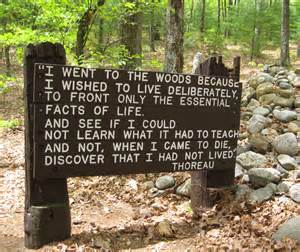
A debate goes on over the question of what, by nature, is man? At a minimum, we find that humans are eminently adaptable, able to live, like vermin or roaches, in the most deplorable conditions. A more fruitful way of framing the question is What is human life? This brings us to the spectrum of cultures to which that of Indigenous people belongs and for whom the world is a living continuum that unites them with their environment. Ecovillages and regenerative communities represent movement toward them, and although they are much more sustainable than the present larger culture, they remain far from the most primitive model. An intermediate experience between the poles is that of Henry David Thoreau which he describes in his celebration of simplicity entitled Walden.
As he lived a short distance from Concord, Massachusetts in the mid-eighteen forties, the author was no survivalist, for he purchased supplies, sold some produce, visited neighbors and interacted with a variety of folks passing through on and around Walden Pond. While his writing consists largely of reflections on his experience of communing with the place and diverse things in it his principal theme is expressed in the words “Simplicity, simplicity, simplicity!” The simple life for him captured the innocence of nature and connected him with his main roots in the earth. One and a half centuries of environmental degradation later Thomas Berry updated Thoreau’s sentiments, writing, “The natural world demands a response that rises from the wild unconscious depths of the human soul.”
The varieties of human experience represented by the three models – Indigenous, Walden and domination by technology – are degrees of attention to life ranging from the most relaxed to the most contracted. For the first presents a continuous world in which individual things are not strictly separated from each other and the subject is aware of and acts as an indivisible part of universal life. In the second the world is experienced as composed of a multitude of different yet interrelated living things such as those Thoreau described in detail, revealing his intimate awareness of their very lives through intuitions of their individual essences and essential relations with each other and himself.
He dwelt among things, in contrast with modern life in general where we are conscious chiefly not of things but of appearances. From direct awareness of the world’s volume in primitive consciousness to the selection of particular essences we move to a basically two-dimensional screen displaying images. More intense cerebral activity further shrinks these to virtually extensionless mental entities, allowing some people to live to a large degree with “their head in the clouds.”
A way to understand this hierarchy of modes of consciousness and things is offered by the philosophy of early twentieth-century philosopher Henri Bergson. For him matter and mind differed only in their degrees of spatial and temporal extension as both were manifestations of a universal substance in which these attributes were indivisibly combined. He stressed the self-evident fact of experience that sense perception is extended in three dimensions and that it directly unites a subject with an external object. The body is one center of action among others in a continuously extended universe, and while he noted organic unity between members of some species and different ones displaying symbiosis, he stopped short of recognizing the full ecological structure of nature which we now accept as innumerable nested and intersecting living wholes. This understanding makes the body both an individual and an organic part of so many increasingly extensive lives of which the most comprehensive is the whole biosphere that is the material base of each individual life. Being an individual as well as parts of larger wholes gives us multiple identities, and, having a unique measure of free will, we can choose the identity in which we wish to act in given situations. This reality is revealed in our common moral dilemmas: Do we act in the interest of some group to which we belong or the environment or just ourselves? In other words, Do we act as our largest, intermediate or smallest selves?
Our actions arise from intentions relative to our different identities which condition our experience with, for example, the broadest intentions of the Indigenous person producing their unified experience. This contrasts with the experience of modern people that is composed of images of countless separate and distinct objects.
A person’s life can be represented by the figure of a cone, at the different levels of which they may chiefly dwell. Its base is the whole universe that is their most extensive and fullest life, while higher levels are successive reductions of that life – actions and modes of life driven by more narrow intentions that literally shrink its spatial extension. About mid-way up the cone is the level of Thoreau’s existence at Walden where he directly touched the local life around him in his activity and consciousness in a way that was a significant reduction of Indigenous life but still much fuller than civilization today.
As matter and mind differ in the degrees of their extension in time and space, the most reduced life is the least extended, and it is at this extreme where much of our lives are lived today, especially in so much information technology which is particularly immaterial. Our intentions are embodied in our physical selves which are extended through our tools that serve limited purposes. Using a tool restricts our intention, as a hammer can drive a nail but it can’t do anything else, least of all serve the good of the world. Conversely, our intention restricts the function of the tool – until now, with artificial intelligence which can make its own decisions independently of us.
Our lives are presently lived close to the apex of the cone, extremely limited in spatial extension, intention and life content, at a very far remove from the fullest most universal life. AI represents the apex point that breaks free from our intention and the cone of life. This is not to say that it isn’t subject to the elementary forces of nature, but, like Frankenstein’s monster, it is no longer our abject slave.
Before the latest Middle East war climate change was enough of a reason to reject fossil fuels, and this reason is now amplified by more war for oil. Our lives are so shrunken by modern culture that increasingly sickens our bodies with AI now driving the proliferation of data centers that pollute and threaten people’s water and electricity supplies. We need to resist them while also digging in to conserve all natural resources. Returning to Indigenous life tomorrow is not an option, nor can we go squat in the woods like Thoreau, but we can seek a large measure of simplicity and the joy that it brings by growing gardens and building regenerative local communities.
Although he disdained men’s hubris, Thoreau seemed to tolerate the environmental exploitation of his time, expressing no fear of escalating, much less apocalyptic degradation, which is precisely what we now face. I liken AI to a point which is a tipping point and, I hope, also a turning point as people rise up against data centers in their communities.
It is further like the golden head of the giant statue in Nebuchanezzar’s dream related in the book of Daniel. Below its head of fine gold were its chest and arms of silver, its trunk and thighs of bronze,its legs of iron, and its feet partly of iron and partly of clay. As in the dream the king watched, a stone separated itself without any human hand, struck the statue on its feet made of iron and clay, and broke them in pieces.Then the iron, the clay, the bronze, the silver and the gold were all broken into pieces which became like the chaff on a threshing-floor in summer; the wind blew them away without leaving a trace.
Data centers are AI’s feet of clay that support the promethean edifice while progressively undermining it with their extreme environmental impacts that might bring modern civilization tumbling down soon.
 Phila Back