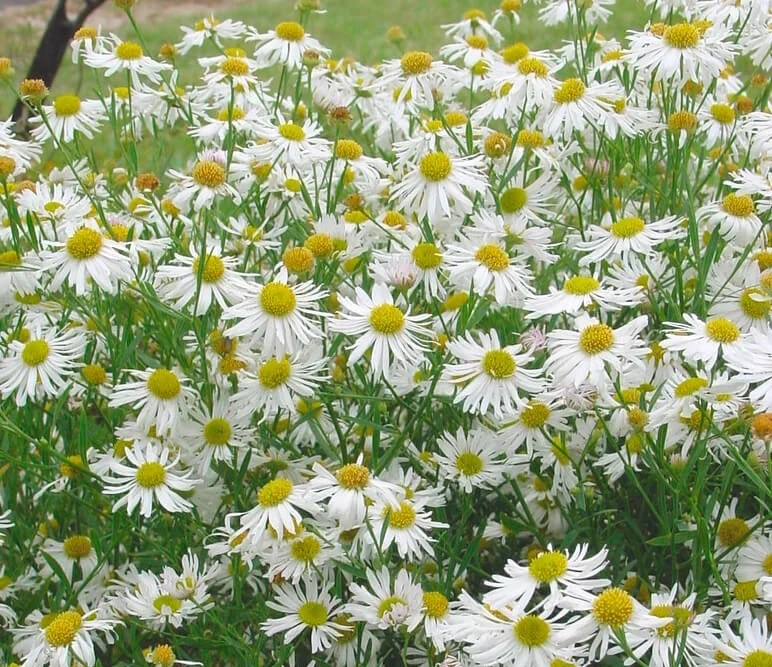
I looked out the window of my back door, noticing particularly a boltonia (Boltonia asteroides) blooming among a mass of New England asters. It had just come up a few years ago on the edge of a stone walk, and I had kept it, hoping that additional ones would grow inside the adjacent bed. None did, but the original one continued to grow and was now a good size with profuse white flowers. A second one had come up a short distance away in the stones under my clothes line, and I let this one grow with the intention of moving it after it was through blooming to a place closer to the first one and the asters. Now looking at that first one, I was conscious of it beckoning me to get on with the job.
What? I have written about my garden in several posts, describing how it is a living whole that includes me, for I have planted it and continuously care for it. In recent years there have been prolonged droughts, and I have kept the plants that needed it watered – even when there was mandatory water use restriction and I bailed out the gray water in my bathtub, carried pails of it down the stairs and through the house out to the yard. I take wilted leaves as cues to deliver water and drooping stalks as signals to install stakes, also splinting partially broken stalks.
Following Aristotle, I hold that artifacts’ forms are their use; for example, a chair is only a chair while someone is sitting in it and is just some wood or other material when unoccupied. Still, when I see a vacant chair I feel a subtle impulse to sit in it – to fulfill its essence. Similarly with my garden which is an artifact composed of living things: I give plants assistance in response to impulses I feel to aid them in fulfilling their lives. Such impulses are entirely inside me and only directed at the plants.
Now the boltonia is the agent and I am the patient. As I have repeated in several posts, the framework of our common understanding is an eternal present. We imagine that things function like clockwork – just continually repeating the same patterns. Yet Bergson has revealed to us that they preserve their pasts within them, and these condition, indeed literally create their ever-new successive present moments. I have added Bergson’s vital temporality to Aristotle’s essentialism to produce an interpretation of the universe in which things have manifold teleological essences and accumulate their pasts within themselves.
According to this scheme the boltonia is a living individual and a part of the whole garden and much else including being a part of the biosphere. Its body, which grows from the roots every spring and summer then dies back in the fall is the accumulation of all of the actions of its past preserved in an inactive state until reactivated, conjoining with external substances to create ever-new present manifestations of its life. Insofar as it is a part of the whole garden its past includes my past actions in it. Further, it has both an individual and collective telos: it strives to live and fulfill the nature of its species and the life of the garden. As an individual it seeks to spread itself and to multiply; as part of the garden it seeks to function in ways that serve both itself and the rest of it.
As I was preparing to write this post I came across a YouTube set in a lovely wild patch of New England asters and goldenrods. The narrator explains that they grow and bloom together, combining to optimize their attraction to bees to whom their colors are particularly visible. He says
Together, these two plant species have co-evolved to appeal to their favourite pollinators, and when these grow together, they have higher pollination rates that not only helps further their genetic success, but makes for more efficient pollen collection for the bees, which is a good thing for all others who depend on them. So in other words, these different flowers have evolved to work together along with the bees to create a system of mutual flourishing in which they all are able to thrive together, and in the process, these relationships create healthy, diverse ecosystems that allows all sorts of other non-human people to thrive, and knowing all of this just makes this pretty sight even prettier, don’t ya think?
My boltonia isn’t quite like a goldenrod, but it is a white native species blooming like New England asters in late summer. In fact in my garden it is continuing to flower while the asters are dying off, being the last of my native species still blooming in early October, thus extending the season for the insects who are now avidly collecting pollen from it. While the connection between asters and goldenrod is spatial, that between the former and boltonia is more temporal. For the latter continue the vital service performed by the asters when they are done.
Everything in my garden interacts with everything else with more or less mutual benefit, and as they are both native species that share natural habitats and perform complementary functions the relationship between the white and purple flowers is definitely more symbiotic than other relationships between species in the garden. The boltonia therefore likes the company of the asters and wants to multiply among them. Its action is the reactivation of motions from its past which, in its nature as part of the garden involve me. As all of its action is driven by the desire to advance its own life and that of the garden as a whole, it wants me to assist it.
We intuit the essences of living things which are their very lives driven by their desires. My intuition of the boltonia therefore includes its desires, among which are some directed at me. With my long experience in the garden and sympathy with it, I am receptive to this appeal.
I am a great admirer of Joe Brewer and his regenerative projects. As his communities, notably Barichari in Columbia, proceed to create self-sustaining ecological cultures practicing agro-forestry, natural features no doubt reach out to the people with guidance. While full earth regeneration requires a great deal of science that goes far beyond intuition, still the goal is life in which all the human and nonhuman elements serve each other for mutual benefit and make, as the YouTube narrator says, a pretty sight even prettier.
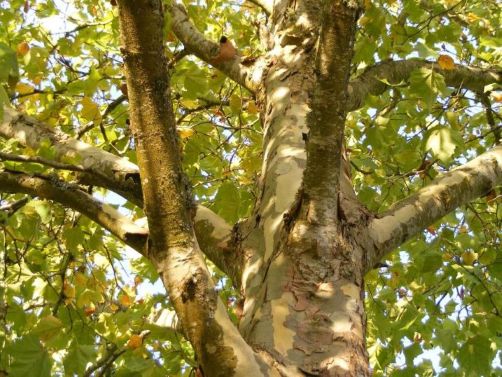
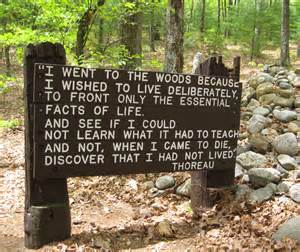
Thirty-three years ago I planted a sycamore tree in my front yard. It had since grown to around seventy feet tall and close to, even touching, the front of the house as it presented an enchanting view from my bedroom window. Sitting on my chair to put my shoes on every day I would gaze at the dense, diversely illuminated foliage moving gently in the breeze that formed a sublime aesthetic composition and brought to my mind Thoreau’s remark
Art can never match the luxury and superfluity of Nature.1
Along with the visual image I was conscious of the tree’s manifold life with its multitude of individual leaves that lived with and for each other. Previously I have written of “dwelling” in life and “living into” natural things, and these are forms of inclusion in the lives of things around us. In the case of the sycamore, my living into it was a special part of my living into my home and yard, the whole back of which is a flower garden about which I have written several posts. So I would dwell in the sycamore’s life, feeling enveloped and sheltered in its leafy splendor.
I didn’t just one day stick the sapling in the ground and leave it alone. Early on I kept it watered but soon discovered a small branch going bare and then dying. After several seasons I determined that it was infected with anthracnose, an incurable fungal disease, thus for many years I have had the trunk injected with a substance that minimizes the damage. Having so cared for the tree I am conscious of its gratitude, as Robin Wall Kimmerer has put it, that as I love it, it loves me. Gazing at the tree from my chair I would luxuriate in the immensely rich experience. This past year I have been particularly attentive to its growth, since in the spring there was a highly unusual late freeze that destroyed all the new leaves. While dismayed, I was confident that it would recover, which it did, getting none of its annual symptoms of anthracnose and growing more lush than ever.
My experience of the tree was fully three-dimensional, for, as I have often repeated, our visual images are outside the image of our bodies, approximately in the places of their objects. The intuitions of objects that accompany sense perceptions are located there also, as in our experience we are functionally conjoined with external objects, making our images and intuitions actual parts of both ourselves and those objects. So my feeling in the presence of the tree was of the same nature as the consciousness of being united with a beloved person near me.
Time figured prominently in my experience, for I have watched the sycamore live and grow for over three decades now, progressively fulfilling my original desire to have a big beautiful tree grace my yard. It had become tall, full and lovely, and from my window I saw into its interior thirty feet from the ground. In the past I have particularly enjoyed beholding trees from such heights, as these views especially give me the sense of living into them. Every new look at my sycamore thus compounded the memories of related past pleasures. In addition, each one was further enriched by additional memories of the species that included recollections of my disappointing effort of trying to grow one as a child and the one I loved in the yard of the house where I lived fifty years ago. My experience of the tree was therefore multi-dimensional, embracing its visual qualities, its vital essence, the total life of the yard plus a good amount of the past that included my care, memories, past desires and pleasures.
From a physical standpoint the tree had increasingly provided shelter from the growing threats of heat, air and noise pollution, prompting me to call it my “green mansion.” It also afforded a refuge from the ever-more extreme stress of current affairs, for I would linger in my sanctuary specifically to escape the strain imposed by the threats of ICE, data centers, immediate climate catastrophe and fascism.
Communion with nature is often spoken of as “transcendent,” but to me, it’s only natural, not supernatural. After he recently passed away writings of Wendall Berry appeared all over the internet, and I was particularly struck by these lines
Outdoors we are confronted everywhere with wonders; we see that the miraculous is not extraordinary, but the common mode of existence. It is our daily bread.2
I also repeatedly saw and was moved by his poem “The Sycamore.”
In the place that is my own place, whose earth I am shaped in and must bear, there is an old tree growing, a great sycamore that is a wondrous healer of itself. Fences have been tied to it, nails driven into it, hacks and whittles cut in it, the lightning has burned it. There is no year it has flourished in that has not harmed it. There is a hollow in it that is its death, though its living brims whitely at the lip of the darkness and flows outward. Over all its scars has come the seamless white of the bark. It bears the gnarls of its history healed over. It has risen to a strange perfection in the warp and bending of its long growth. It has gathered all accidents into its purpose. It has become the intention and radiance of its dark fate. It is a fact, sublime, mystical and unassailable. In all the country there is no other like it. I recognize in it a principle, an indwelling the same as itself, and greater, that I would be ruled by. I see that it stands in its place and feeds upon it, and is fed upon, and is native, and maker.3
Berry’s words were most timely for me, as my sanctuary had just been destroyed. The tree had grown to touch the house and a few branches were lying on the gutter along the roof, blocking it and causing rainwater to pour out the end in a torrent. In the past I have stood on the roof of the porch and used a pole pruner and pole chain saw to trim branches blocking the gutter. But the worst obstruction now was on the corner and I didn’t dare try to wield one of those tools standing on the edge of the porch roof. So I called the fellow who had previously done gutter work and a little trimming for me. After telling him to cut the branches “lying on the gutter,” I left him to the job and later came out of the house, devastated to discover that he and his crew had cut all the branches to within twenty feet of the front of the second floor!
As my initial shock passed, my thoughts turned to the topic of my thought at that time – regeneration. So I consoled myself that the tree would regenerate, in fact as I had observed it do before, grow back more vigorously than ever. Yet the loss was a forceful reminder of how the people around me not only don’t value trees, but are actually keen on destroying them. A next door neighbor compulsively cuts any vegetation hanging over his yard from neighbors’ properties – acts of violence which the sycamore always vigorously overcomes.
In any case I felt violated and alone, forever a voice in the wilderness. But then I found a comrade – Berry, who not only shared my values but was an iconic defender of them his whole life long. Reading his lines added to my past, my resources and my power, as his work has done to human history. We are never alone; the past is always accumulating and building both our capacity and will to act.
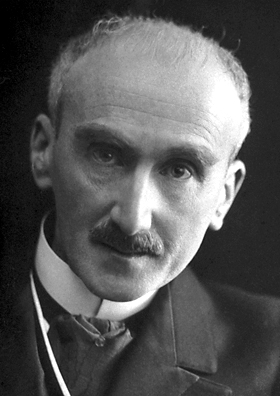
I have written extensively on the philosophy of Henri Bergson and my amendments to it. For him sensory images present choices for action, the selection of which is determined by one’s attitude that I have expanded into intention, but, like him, still treated as distinct from the choices offered. Bergson’s thought bears some resemblance to Nietzsche’s in that the former has an evolutionary force, the élan vital, running through the universe, striving for ever-greater freedom from the restrictions of inert matter. Nietzsche, meanwhile, has the universe consisting of units of power that always seek more of it. While matter for the French philosopher is the past continually repeating itself, it is the substance out of which the ever-new present is continually created. The dormant past, he says, presses against the present seeking to reactivate itself and does so by degrees, first manifesting in sensory images and then, if selected, physical motions. Yet as life is indivisible, it is evident that intention directs one’s accumulated past. We carry our continually growing past into every successive present moment, bearing a burden that is in fact a treasure which we can use to achieve potentially marvelous effects.
The past is ever accumulating as resources for action, and, with consistent intention, compounds the power of the agent, injecting Nietzsche’s will to power into Bergson’s life force. According to my amended version of his vitalism, entities by nature seek to serve their own and all of the intersecting and nested of which they form organic parts with only human freedom preventing us from consistently following this course.
In acting we need allies and resources accumulated over time, and while the former may seem scarce, our cultural heritage, which I have previously called a gold mine, is a force. Thus reading Berry’s lines strengthens my resolve. His existence in the past in fact contributed to the previous achievements and persistence of the conservation ethic today. Berry lives on not only as enduring energy from the past, but also as an icon directing people’s intention to continue his legacy.
I have repeatedly advocated holding the ideal of the ecological civilization with continual effort directed at it that is distinct from inertia insofar as it is adapted to ever-new present conditions. While Aristotle said that virtue is a habit, the consistent action I am prescribing here compounds and increases its effect. Still, Bergson makes a serious point about life pushing through the resistance of matter. As we all know, seeking the ideal is very hard work, and here Berry offers crucial inspiration.
In the poem he stresses the unity of the sycamore and its environment from which it draws its sustenance, a less visible feature in our experience of the species. Instead, we are always impressed by its outstanding height, girth and distinctive patchy white bark. While we don’t need Berry to tell us that the trees are towers of strength, his poem reminds us that they are monuments of endurance.
With so much foliage removed from in front of my window, the chief object of my view became the tree’s trunk – tall and mighty with its wonderfully variegated white and gray surface. No more verdant bower; now the tree’s gleaming mass and muscle confronted me! As it had been stripped somewhat naked, I felt as I had been so as well, shaken out of my comfort and forced back into the battle of life.
Baudelaire found nature to be “forêts de symboles,”4 recognizing that our common symbols are not arbitrary but are taken from nature because symbolism is precisely the medium in which it communicates to us. Moreover, natural objects don’t just exemplify qualities, they convey messages – a phenomenon well known to Indigenous peoples and related in laymen’s terms in several books by Ted Andrews. A fundamental premise of his work is that messages are received at key moments in our lives. Perhaps this is just a matter of critical events turning our attention to things that have been there all along or maybe there is a special signal from the universe.
In any case I took the sudden central appearance of the tree’s trunk as a message, initially to give up escaping and muster courage to resume my previous level of activist engagement. The present time is discouraging and exhausting, so I had withdrawn a bit, especially since my last organizing project had not received the support that I expected and needed, leaving me feeling somewhat defeated. In addition, some personal health issues had contributed to my reduced activity. Having the sycamore damaged was about the last straw, but then, out of the past came Berry’s words to lift my spirits. Reading those about the miraculous established him as a kindred spirit, a comrade who compounded my power, while the poem elevated him to an icon for me to strive to emulate.
In that work the sycamore is portrayed as tirelessly advancing its life through trials and tribulations, drawing support from the earth. This is precisely what Bergson says life is – a force for which matter supplies both resources and resistance. The opposing force of matter is inertia which threatens life from the inside as well as the outside, for humans, possessing free will, can lapse into indolence. Unlike in nonhuman things, unceasing whole-hearted effort is not a given, and this is why humans must continually be exhorted to practice the classical virtue of courage.
Now looking at the exposed sycamore trunk I see courage and receive the message “Have courage.” “What more do you want to tell me?” I ask it, and it enthusiastically replies by bringing my attention to its growth. Life is always growing, never sinking into unchanging routine or worse, decay. So as I take courage and move forward I notice that where previously the leaves, branches and trunk were fairly heavily shaded, part of the latter is now brightly illuminated by sunlight. This tells me to get out and become visible. In addition to its big solid parts the tree still has an abundance of leaves, reminding me of Yeats’ lines
O chestnut tree, great rooted blossomer, Are you the leaf, the blossom or the bole? O body swayed to music, O brightening glance, How can we know the dancer from the dance?5
The tree is a living whole, with the leaves belonging to the trunk and branches, as, conversely, those belong to the leaves. Berry’s poem further highlights the unity of the tree and the earth, ultimately it and the entire universe.
Like individual leaves, minor actions are important, and there are lots of them in which to engage. So I took the opportunity to attend an event in order to share some important information with several group leaders. However, with one exception, they didn’t want to hear it, as they were locked into the narrow missions and agendas of their identity groups. I therefore left the event feeling discouraged and thinking, as I have sometimes done, that they have everything they deserve.
Still, there are many other small opportunities that do include joining the identity groups’ limited projects. Social media has become an extremely powerful platform for individual action, and I receive excellent content from the national organizations that I follow. Clicks are absolutely minimal motions, but if they go viral they can have immense impact.
Looking out my window I previously saw profuse foliage in front of the tree’s trunk, but with that clear I now look directly at the stately column, behind which is a mass of leaves. The trunk tells me, “Be strong,” while the leaves tell me they have my back. Berry’s voice, which endures, calls on us to take our cues for living from nature, and turning to it, we find it giving us explicit direction: Be strong! Have courage! Pursue small opportunities! Act! We have your back!
Natural things are models of virtue, but in addition to them we need such models in human forms. As Berry is a model of a life dedicated to conservation, each individual should strive to be one as well, for acting thus does have some impact which we can hope will multiply.
I have previously written in Plenitude how I rejoice and find deep comfort in dwelling in the manifold continuity of life in my garden, while Silent Stalwart describes the moral support and inspiration I receive from my brown-eyed Susans. Berry has become an ally and icon for me, functions that are in fact now much more powerfully performed by my sycamore as I daily gaze upon the white and gray titan, noting the profusion of leaves around it. These continually seek pathways to sunlight through the shade cast by their fellows, literally building the power of the branches and trunk while the whole is supported by far-reaching roots firmly embedded in the earth.
NOTES
Henry David Thoreau, A Week on the Concord and Merrimac Rivers, (New York: Thomas Crowell Co., 1911), 397.
Wendell Berry, The Art of the Commonplace: The Agrarian Essays, (Washington, D.C.: Counterpoint, 2002), 311.
Berry, “The Sycamore.” in The Collected Poems of Wendell Berry 1957-1982, (San Francisco: North Point Press, 1985), 65.
Charles Baudelaire, “Correspondances.” in Les Fleurs du Mal et Autres Poèmes, (Paris: Garnier Flammarion, 1964, Paris), 39.
William Butler Yeats, “Among School Children.” in Selected Poems and Two Plays, ed. M. L. Rosenthal (New York: Collier Books, 1962), 117.
For Bergson the immediate awareness of time is found in the intuition of Becoming, a relaxed state of consciousness wherein indistinct qualities are perceived within a temporal interval in which present contents pass into the past, becoming memories, as those and other memories interpenetrate the present flow. This interval is a continuous moment of duration in which the past is prolonged into the present in the form of conscious memories of the near-term past. Bergson’s whole system is complicated and entails the tenuous claim that image memories are stored in a spiritual past realm, so I have amended it to accord more with actual experience and provide timely moral guidance. Still, there are at least two points that require clarification. The first is how duration is commonly experienced and the second is how the remote past can re-enter the present in memories such as in Proust’s famous tea-soaked madeleine experience.
For the first point Bergson offers the example of hearing a bell tolling which is a succession of separate sounds that one hears as a continuous whole. This is a poor example because he omits to specify the period and rate of the sounds. A much better illustration is hearing a cicada buzzing for around thirty seconds. While one seems to hear it as a temporal whole, it is actually a series of separate short clicks. We hear each one as it occurs in each successive present moment and hold them as conscious memories within a single moment of duration as they continue and add to the series of such memories. It’s like adding beads to a string, except it’s in time, not space, so we’re aware that the earlier clicks are past and not present.
Within the universal Becoming there are two kinds of action: ever-new present ones and repetitions of past ones. All of the past is preserved in some repetitive material form, as a rock, for example, remains the same as it repeats its past action indefinitely. Humans meanwhile have bodily memories in which past actions are retained in dormancy, like a dance step that is learned in the present and retained in the body until it is repeated at a later time. Although for Bergson image memories are different and are stored, as I have mentioned in a separate spiritual realm, he has bodily and conscious action both originating in the body either as physical motion or virtual bodily action that is projected onto external objects and reflected from them as images.
Since I have explained that process previously here and here I will proceed to discuss present sense perception as just a matter of projecting memories onto present external objects. Bergson describes this at length in Matter and Memory, detailing how such memories are mostly generic, not particular, in order that virtual action should pass into habitual bodily motions. Our action is not always reflexive, and we may pause and study the objects before us, bringing forth more particular memories that illuminate additional aspects of them.
For Bergson the initial reflections of virtual action from objects are “pure perceptions” which embody their actual sensory qualities but are not yet conscious. As they are subsequently overlaid with image memories that come forth from their separate spiritual abode they become conscious perceptions. He therefore has virtually all of our sense perception consisting of memory images and not the sensory qualities of objects presently before us. In my amended scheme, images are formed by the functional conjunction of our projected virtual actions and those of external objects. Virtual actions repeat the past and therefore are past, while the conjunction constitutes a new moment of Becoming and is therefore present. Sense perceptions are thus amalgamations of present and past contents in varying degrees.
Accordingly, much of our common experience is composed of projected generic memories rather than the particular qualities of present objects. A great deal of it is also recognition of previously seen objects, and this involves quite particular memories projected onto their objects. To wake up every morning and see my room as the same is to repeat such past experience which yet exists in the context of the present. For I think of what I will do today that will be different from what I have done on previous days.
We live in temporal contexts in which change is ongoing, yet some experiences can seem to return us to past time. Sense perceptions are accompanied by feelings, some of which are particularly pleasurable, and repetition of certain images may reactivate such feelings. Dwelling on an image and the feeling may draw forth associated memory images, as the memory evoked by the taste of the tea-soaked madeleine swelled into a vast recollection of Combray for Proust. As it overtook his present experience, it seemed to transport him into the past. Not only was his consciousness filled with memory which, as repetition of the past, was the past, it was accompanied by the distinctive feeling of nostalgia that characterizes such sustained attention to the past.
A fine example of this phenomenon that people may be able to relate to is how an especially tender early moment in the romance of Swann and Odette coincided with hearing a certain musical phrase in a performance. For long afterward, hearing that phrase brought back the memories of the occasion and their exceptional pleasure. With these memories they literally relived that past precious moment.
My life-long fascination with time has led me into increasingly deeper study and reflection on Bergson’s work. Understanding of both it and time itself have developed – fittingly, over time – and this article presents my latest advance in that endeavor.
In the current polycrisis of escalating climate change, growing authoritarianism and increasing wealth inequality many people feel that there is little, if anything they can do to resist it, and together they compound each other’s despair. Their attitude reflects our culture’s definition of people as radical individuals that are parts of so many essentially mechanical systems, all obeying Newton’s First Law of Inertia. Yet now a growing number of thinkers are calling for system and worldview change, offering a variety of visions of regeneration, transformative adaptation and ecological civilization. A number of diverse efforts are presently underway to achieve these goals, and, as an issue and electoral organizer, I have considered and followed several of them, noting particularly their transience. We retain the Enlightenment’s conception of time as a series of discrete instants that are represented by points on distance/time graphs, and that era’s myth of progress adds to our excessive attention to the present and relative disregard for the past and future. Visionary plans or designs are frequently blueprints – representations of fixed structures that exist in the present and inadequately address how they are to be established and sustained, how they shall adapt to changing conditions and, above all, how they shall retain people’s engagement. The fact is that projects come and go all the time and so do their participants. As people wrestle with three-dimensional designs, prototypes, fractals and so forth, they fail to give adequate attention to the crucial fourth dimension – time. Insofar as this defect extends to the alternative worldviews they construct as well, my objective is to properly explain what time is and the place it occupies in our quest for a more ecological civilization. True understanding of time opens up infinite opportunities for people to individually and collectively improve the world now.
The present cultural attitude toward time is known as “presentism” or “nowism” which holds that the present is what is important, while the past is disdained and dismissed. Yet our cultural heritage is a gold mine; indeed past understanding is the material from which all present knowledge is constructed. So I bring back from the past some ideas and apply them to our present situation to create a new view and method of acting that serves our current needs. First I review the contrast Kierkegaard drew in Either/Or between momentary and enduring action which raises the matters of both temporal and spatial continuity of people’s lives. Next considering spatial relations, I proceed to the current attention to resonance and presence. In nature the latter is found to contain the past, and I continue with a summary of Henri Bergson’s doctrine of the retention of the past in the present. I then amend his system by developing its underlying essentialism which yields a full philosophy of nature that provides clear direction for action, the practice of which is illustrated by the work of Joe Brewer’s Earth Regenerators. As most people’s environments are urban or exurban habitats, their life action must be more of the nature of Rupert Read’s transformative adaptation. All life is in fact transformative adaptation, and with the proper intention, we can all constructively engage in it all the time, most effectively when we persistently work together.
Either/Or
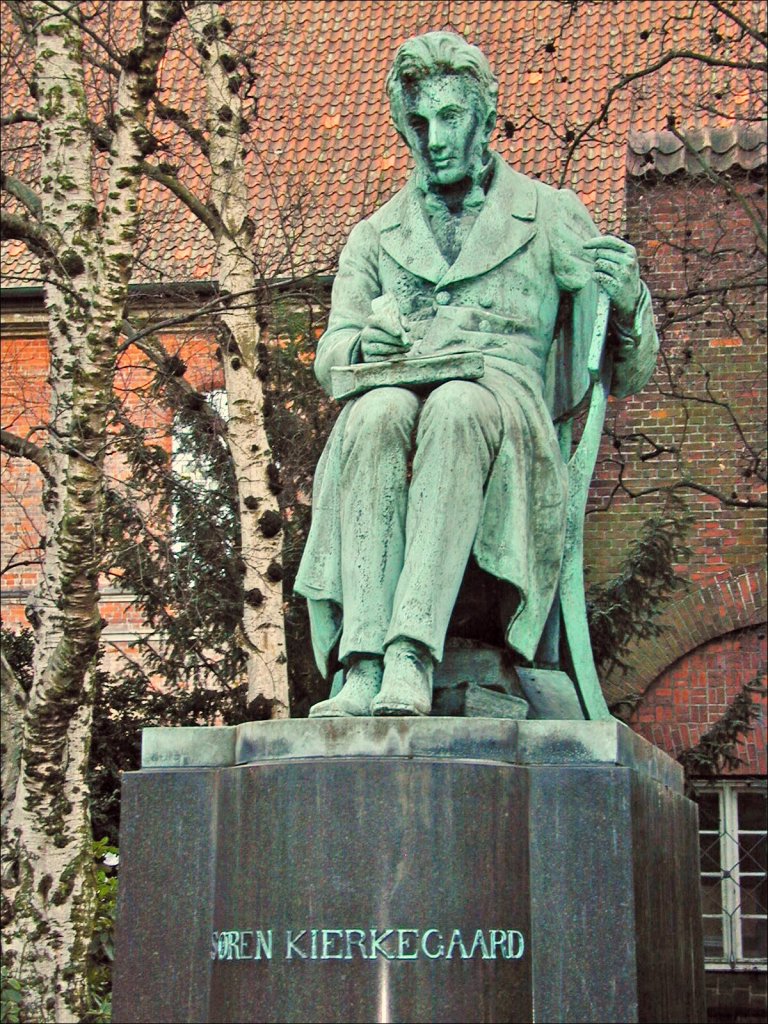
Soren Kierkegaard is best known as the father of existentialism who sought to mediate its radical view of human freedom with Christianity, presenting the case in the form of a letter published in his 1843 Either/Or. It is directed to a man who, according to him, lives the “aesthetic” as opposed to the “ethical” life. The former consists entirely of the pursuit of sensory pleasure and is epitomized by the character of Don Juan in Mozart’s opera, whom Kierkegaard calls a “sensual genius.” That legendary libertine is represented as having seduced a thousand and three women, with each of the acts having no antecedent or sequel; they are all like the supremely pleasurable and unique first love. These are therefore momentary experiences, unconnected to any preceding or following them, and the writer claims that the aesthetic life is such a series of disconnected moments saying to the recipient, “You exist in the instant.”1 It is thus distinguished from the ethical life, the primary relationship in which is marriage that embodies continuity, shared history and direction for the future.
While the aesthetic life is determined by things that are external to a person, the ethical life, Kierkegaard says, is directed internally by the continual exercise of one’s freedom. With any particular free choice one is also choosing freedom itself, placing themselves in the Absolute, the ultimate reality underlying particular things, contingency and sensory phenomena. This is the realm of universals, and, dwelling in it, a person’s actions exemplify universal ethics as revealed by their conscience. Moving through their life that is spatially and temporally continuous with the world and in which they perform a variety of functions involving family, work and civic life the ethical individual builds their history, that is, their character, and positively impacts the world. The ethical person’s acts, he says, are to be performed as duties the fulfillment of which gives them satisfaction. Above the aesthetic and ethical realms sits God, and the philosopher makes clear that in both humans are necessarily imperfect; in fact saying, “As against God we are always in the wrong.”2 So beyond aesthetics and ethics redemption consists in loving God and being loved by him in return.
Space/Time
Since Kierkegaard wrote existentialism has progressively shed religion while retaining its basic conceptions of individuality and nearly limitless human freedom. The aesthetic life Kierkegaard described is today the norm, with time divided into separate short periods, if not instants, as well as people living in ways spatially disconnected from other people, the places they inhabit and nature in general. A movement is now in progress to re-establish not only connection but actual, indeed organic unity, among the myriad broken pieces.
Resonance
Radical individualism is a tenacious idea, but some people are beginning to tackling it with the notion of “resonance” to describe how people approach and affect each other as well as some nonhuman things. The word means echo, which is sound reflected from some solid surface. So to say that one “resonates” with certain people or things is to say that those echo one’s own nature or reflect it some way that is colored by their nature, with the individual metaphorically functioning as both the transmitter and receiver of electronic signals. This representation of resonance reduces it to mechanical terms, but its function in organic processes is illustrated by bats’ echolocation whereby they emit high frequency sounds whose echo or reflection they hear as audible maps that guide their flight through caves. Common use of “resonance” however tends to refer to static rather than dynamic conditions.
Presence
The dominance of the spatial as opposed to the temporal perspective is also found in the current notion of “presence,” which is taken to mean being here, beside or near. Presence doesn’t necessarily imply things existing separately side-by-side but in a more diffuse manner as we say that someone’s presence was comforting or that it influenced a gathering. Such spatial continuity in nature is suggested by Thoreau’s observation
In swamps, where there is only here and there an ever-green tree amid the quaking moss and cranberry beds, the bareness does not suggest poverty. The single-spruce, which I had hardly noticed in gardens, attracts me in such places, and now first I understand why men try to make them grow about their houses. But though there may be very perfect specimens in front-yard plots, their beauty is for the most part ineffectual there, for there is no such assurance of kindred wealth beneath and around them, to make them show to advantage.3
In addition to breadth, this presence also has depth, as he says
Art can never match the luxury and superfluity of Nature. In the former all is seen; it cannot afford concealed wealth, and is niggardly in comparison; but Nature, even when she is scant and thin outwardly, satisfies us still by the assurance of a certain generosity at the roots.4
While such presence for Thoreau was also basically spatial and therefore static, Aldo Leopold, who had an intimate awareness of nature, captured the dynamic aspect of presence in his Sand County Almanac entry “Thinking Like a Mountain.”5 When wolves inhabit a landscape he says, their presence conditions all other things including the vegetation which is protected by them keeping the deer population in check. Their howl fills the night, as every potential prey animal is ever on alert to sights, sounds, scents and signs of their approach. The lives of wolves not only intersect with the lives of things around them, they deeply interpenetrate them, as these apex predators may be said to live into the whole place.
Still, being present is persistently understood to be in the present – the present time – as people are admonished to refrain from directing their attention to the future instead of the present. Though “Thinking Like a Mountain” is about presence in the ever-renewed present over the course of time, Leopold offers subtle insight into the presence of the past in his entry “Good Oak.” There he describes how he and some friends sawed up a one hundred-year-old oak tree near his farm that had blown down in a storm. They cut it by hand, progressively sawing into the rings of the trunk that were historical records of not only the tree itself but also the place, for the tree was present in the place as, conversely the place was present in it.
Apparently not explicitly aware of such truth, Leopold implies that the tree’s rings aren’t just records of the past; they are the past preserved in the ever-renewed present. This is no idle thought, for I am personally conscious of past time preserved in big trees. Indeed, a tree is a living heritage, and this is why the destruction of trees symbolizes the annihilation of certain heritages or pasts. Examples of this are the fall of Yggdrasil which marked the end of the world ruled by the Norse gods and the destruction of the cherry orchard in Chekhov’s play that symbolized the end of the whole feudal order in Russia. While big old trees, forests and orchards are particularly striking instances, all plants, all organisms and all of nature are living heritages as well.
Becoming
My discussion so far has illuminated how in our common understanding and practice space and time are discontinuous: sensory experience, while not instantaneous, is taken to be a series of moments whose content may be some reflection of ourselves, and although we consider all objects to be separate and distinct, we in fact have an obscure sense of their extended presence. We are also dimly aware of the preservation of the past in certain things, notably big old trees, but find that incomprehensible. Bringing Kierkegaard’s Either/Or to bear on these matters may seem arcane, however it was he who formulated the notion of existential freedom, and the issue of freedom remains central in our lives.
I have written extensively about the human action that is needed now to turn away from the status quo and address the polycrisis, drawing much inspiration from the early twentieth century French philosopher Henri Bergson whose work focused on time. I don’t think anyone will deny that his work is difficult to understand, but the effort to do so is definitely worthwhile and is something in which I have been engaged for several decades. Recently I published The Timely Wisdom of Henri Bergson in which I attempted to present a full account of his philosophy with some amendments of my own. He unequivocally states that material objects repeat the past in the present, but while I correctly followed him in stating that the present is continually created, I mistakenly claimed that the past is recreated in every present moment. After I completed the article I was dogged by the conviction, based on personal direct experience, that the past is literally preserved and present in big old trees. Reflecting on his ideas I finally understood the subtle truth that he reveals, and I am writing this article to correct my error and amplify projects going on now that embody my philosophy of action to meet today’s urgent challenges.
As Bergson asserts, the universe Becomes, and the absolute Becoming of things is well illustrated by the life of a plant which temporally extends its existence into each successive present moment while also spatially extending itself with new growth such as the addition of rings to a tree’s trunk. Each year a tree grows a new ring at its circumference as the inner rings no longer grow but form its substance or matter within which fluids continue to flow.
Among the variety of terms that Bergson uses to describe the past the one that applies here is “inactive,” and to illustrate the difference between active and inactive I move to the human body. I learn a dance step in the present moment which passes away into the past. Then at a later time I repeat that step which had passed from activity into inactivity and was preserved in that inactive or dormant state in my body until I re-activated it. Of course the body is alive and remains active in many ways, but not with respect to the dance step while it is inactive. Similarly with the tree rings: in its first year a ring grows, then that growth ceases and becomes its past or a ring that no longer grows.
In Becoming a thing perpetuates itself, which includes both its active and inactive functions, into each successive present moment. Simply distinguishing present and past as active and inactive makes the difference one of degree that only becomes significant when it is seen how the past continuously re-enters the present either as bodily habits or conscious memory images. Habitual bodily functions represent the reactivation of motions that continually pass away into the past, for example, the motions of walking which are inactive or dormant when we are sitting.
Bergson defines the body as one center of action among others in a continuous universe where they all interpenetrate each other. In Becoming they mostly repeat their pasts, and this constitutes their materiality, for however far we go in reducing “material” things, we will never reach anything permanent. As Heraclitus said, “Panta rhei.”
So the universe is a multitude of actions, among which some are ever-new as they continually Become while others repeat in every successive present moment their previous actions in dormant states which are their pasts in their pastness. Dormant actions are not inert, for they may be reactivated, and this is especially evident in animal life.
The primitive animal, the amoeba, is a collection of habits for which touching an external object is an elementary sensory experience that activates a particular one. While inactive these habits constitute its past from out of which the selected habit re-enters the present immediately, since the amoeba has no advance notice of the object’s proximity. That is precisely what more advanced forms of perception provide: we see, hear and smell things located at a distance from our bodies, and these senses enable us to prepare – to choose which habits we activate in response to them.
Within the Becoming universe particular things are centers from which action radiates, with all interpenetrating all. This action exhibits varying degrees as, for example, the difference between the physical action of the body and actions that lie dormant within it. As a seeing, hearing and smelling subject, the body radiates – to be exact, projects – habitual actions in a virtual state onto the objects around it. These are potential actions determined by its intention at the present moment that Bergson says are reflected from those objects in the form of images which represent the body’s potential action upon them. As a multitude of objects surround the body, these images represent a plurality of possible actions from among which the subject can choose to actualize one. In short, perception is a preview of bodily memories which the body can re-activate in the given situation as they apply to the objects at hand. Although this is a very unusual interpretation of sense perception, it is true. Our visual images are literally located outside the image of our body and they indicate what our body can do to the objects so represented – where we can touch or grasp them and how far it must move to make contact with them.
So far I have faithfully followed Bergson’s position, but now I proceed with my own amendments to it. For him, the “pure perception” I have just described isn’t conscious, and it only becomes so when image memories, which he equivocally says in Matter and Memory are stored away in a separate spiritual realm, come forth to overlay and merge with it. Conscious perception therefore becomes like cinematography, consisting of a rapid series of still images.
He takes this view not only to explain consciousness as a spiritual phenomenon, but also to resolve some challenging issues with perception itself. The universe is a spatial continuum with things being qualitatively different but not distinct, so how is it that we see countless discrete objects? Further, while the world isn’t entirely in rapid flux, there is continual change, so where do we get the sense that anything is permanent and unchanging?
Using the analogy of energy physics Bergson has the process of perception contracting light’s high frequency or very short moments of duration into the body’s longer moments of duration, thereby producing perceptions of colors. He also comes very close to identifying matter with low-frequency and consciousness with high frequency energy, with the latter approaching, and at the extreme passing into, spirit. While this analogy with scientific theory conflicts with his position that science is a conceptual construction and that only Becoming is real, there is truth in his concept of “rhythms of duration.” Matter can certainly be understood as repeated past actions, and nature does seem to be universally cyclic, with different cycles simultaneously going on at different rates. The human body clearly illustrates this with its various rhythms or cycles of blood circulation, respiration, digestion, reproduction, sleep and waking, and these are correlated with terrestrial and planetary cycles such as the earth’s rotation and lunar revolution. While these latter are invariable, some of the body’s rhythms vary, as our breathing and heartbeat speed up with exertion. So although rhythms of duration certainly exist, they can’t be exactly determined.
Perception does in fact contract the spatial and temporal continuity of things into discrete, somewhat constant images, and this, I say, is due to the projection of virtual bodily memories onto external objects that produce sensory images. For Bergson such images are reflections from these objects, and he compares them to mirages in which light reflected from clouds produces images of water on the ground – a phenomenon reducible to the physical natures of light, clouds and bare ground.
In the Becoming universe things are not physical entities but particular configurations of the universal life, and in perceiving something the body forms a functional conjunction with it that produces the image. Like moving its limbs, consciousness is a function of the body, and although it is different from such motion, the two exist on a continuum in which consciousness can pass into motion and vice versa. This is seen in the passage of virtual action into images and images into physical action.
Thus I, a seeing subject, approach a visible object with a certain intention, and in these capacities we functionally conjoin and, doing so, form an image. As this image is an extension of my life, it is also one of the object’s, and we are literally united in it. It forms from my projection of certain bodily memories in a virtual state subject to my present intention, so it represents a particular search to which the object responds by presenting its qualities relevant to that search. For example, I want to walk down the street and look ahead of me with that intention. The street for its part contributes to the image a view of itself as a fairly homogenous level surface from the perspective of my body. If, on the other hand, I drop a coin on the street and look to pick it up, I see a pebbled gray surface upon which the coin might stand out as a silver disc. In general, we see what we want to see and the aspect in which we want to see it.
The conjunction of virtual actions or bodily memories in a virtual state with external objects further effects a contraction of otherwise indistinct and impermanent qualities into distinct and more stable images. A sphere of consciousness exists around our bodies, and it is a zone of contraction, reduction and intensification of life energy, commonly known as attention. The contents of images are certain functional conjunctions of the subject’s virtual action, determined by their intention, and the object’s nature. Seeing an object at a distance entails a delay in a bodily response, and in the interval, one focuses their attention upon it. This means not only sustaining, that is, continuously repeating, the projection of the particular virtual action, but also, as Bergson explains, having further memories come forth that illuminate sensory details in the object and bring past experience to bear on the choice for present action. I don’t just examine the object, but I review what is likely to follow if I choose this or that move, in other words, preview the effect.
The philosopher is absolutely correct to say that memories crowd into present perceptions but, as he has intact and discrete memory images coming forth from their separate spiritual abode, this means that, although they are re-activated by merging with present perceptions the process is discontinuous, thus producing the cinematographic effect. In reality memories re-enter the present as virtual actions in the way that I have just described for the purpose of producing perceptions of external objects.
We can, of course, form memory images separately from external perception. The latter consists of virtual physical actions conjoined with the natures of external objects which, like actual physical motions, pass away from the present into the past and are preserved in an inactive state as the body continuously repeats its past while otherwise Becoming anew at every successive present moment. Therefore, like bodily movements, such preserved perceptions can be re-activated. If the previous external object is present, the virtual action projected at it is the particular past one, and the actual perception that is formed is one of recognition. If that object is absent the past image must be re-activated by itself and therefore appears substantially reduced and held in consciousness by heightened attention.
So the body is a collection of preserved habits that are selectively projected as virtual actions onto objects in its environment over the course of its continuous Becoming. First conjoining with those objects to form images, chosen virtual actions proceed to become actualized in ever-new present moments.
Along with sense perception Bergson recognizes the conscious function of intuition. His earlier writing describes it as immediate consciousness of Becoming – a very relaxed state of mind in which qualities appear indistinct, continually come into being in the present and flow away into the past while memories appear, interpenetrating the present. This intuition, he says, is directly knowing Becoming as oneself Becomes. While Matter and Memory constructs memory and perception entirely from sensory experience, he later in Creative Evolution adds an intuitive component to it. Sense perceptions, he says, form the nuclei of experiences in which intuitions of objects form the fringe and through which we might directly enter into those objects in acts of sympathy.
Also in that work he asserts that evolution has diverged into the two pathways of instinct and intelligence exemplified by the amoeba and humans. The former, as I have indicated, is barely conscious, reacting automatically to sensory stimulation. Human intelligence is focused on the materiality of things, much of which it constructs itself by overlaying the immediate flowing content of its consciousness with still memory images. This process, Bergson says, “spatializes” time by appearing to lay out unchanging objects side-by-side in an homogenous space. An intelligent being is particularly adapted to working with inorganic substances and making tools to facilitate that work, while the amoeba’s life is confined to continually repeating its past, functioning at only a slightly higher level than a rock. Humans escape such inertia with faculties that permit them to choose among alternative courses of action, and their freedom is exponentially increased by their further power of contracting images into ideas and technology. All this represents so much contraction or intensification of the natural flow of Becoming evident in the immediate intuition of it. Presumably the intuition existing on the fringes of sense perceptions is immediate consciousness of the Becoming of their objects.
Although Bergson has everything being spatially continuous, interpenetrating and flowing into each other, he does have the body being a center of action with a highly complex anatomical structure that demarcates interior and exterior. Also, as in Creative Evolution he acknowledges co-evolution, symbiosis and the unity of populations of some species such as bees, he clearly recognizes the individuality of things which is nothing other than their essences. He is a vitalist, and the objects in his universe are precisely Aristotle’s essences to which have been added full ecological and temporal natures.
They are alive in a total living universe composed of innumerable intersecting and nested whole lives. This means that their lives are manifold: they have multiple identities as individuals and as parts of so many larger wholes. Try as he might, Bergson can’t avoid teleology, for organisms are obviously moved to remain alive and to proceed through the stages of life from infancy to adulthood. For him the goal of evolution is ever-greater freedom from entropy and inertia, but this notion is outdated, as we now accept the basic Gaia conception, and man’s freedom has landed us in today’s likely catastrophic polycrisis.
All the lives in the universe, up and down the chain of being, are essences with their own final causes, both insofar as they are wholes and parts. Accordingly, as an individual, my purpose is to live and to perform my essential functions, while also, as a part of nature, my purpose is to serve it, and likewise with respect to every whole of which I am a part. Though nonhumans do this automatically, humans are unique in possessing free will and are therefore at liberty to decline to function in any or all of these capacities.
I have repeatedly advocated for people to fully live by acting to the best of their ability in all of their identities, but what exactly does this entail and how does time figure in the plan? After briefly mentioning the intuition that accompanies sense perception, Bergson does not pursue the prospect of entering into the Becoming of things through it except in his final book to propose a major exploration of spirituality. We need not look into an after-life, because our experience already abounds with intuitions of the essences of things. Sense perception presents us with colors, shapes, sounds, sensations and so forth, but alongside these effects, we are immediately aware what things are. Thus, I am aware of the very life of my cat, which is distinct from her color and shape and has the quality of “catness.” Like my visual image of her, my intuition is located in the space of my experience, outside the image of my body and approximately where the cat is located. Bergson says that entering into the Becoming of things requires “sympathy,” and intuiting my cat’s very life requires, at a minimum, an interest in that life. The aspects of things that we perceive with our senses are determined by our intentions, and the same is true when it comes to intuiting their essences: I just consider the shapes and colors of things because I want to, and I similarly intuit their essences with an attitude of sympathy. For in sense perception I functionally conjoin with the object insofar as it is sensible, giving rise to the sensory image, while, intuiting it I functionally conjoin with its very life, with this act producing the intuition. Conscious of its life, I care for my cat by feeding it, giving it comfort and affection.
I in fact have two cats, so I perform these actions for both of them – providing sufficient food and water, space on the bed and tracking their coming into and going out of the house. Some people have multiple species of pets, so they perform different actions that are determined by the animals’ different natures. The variation of action increases with the variety of animals which might include a number of domestic kinds such as chickens and cows. Keeping farm animals requires structures such as chicken coops and barns as well as fenced pastures, so the care becomes not only diverse but also complex. The care giver’s life becomes more integrated into those of the animals, so the farmer lives on the farm and works full time to maintain the lives of the animals, the crops and the property. They no longer “enter into” this thing and that separately but rather “live into” the whole set-up. Because the farm constitutes the farmer’s livelihood, they care for its life as they care for their own body. Such care is an obligation for their life – a duty – as Kierkegaard would say, which is guided by their intuition or conscience.
Bergson’s model of sense perception also applies to intuition: it originates with the virtual projection of a bodily memory determined by a particular intention. And although the intuitive component may be minimized, sense perceptions and intuitions are in fact inseparable. Our attention may be focused on the sensory qualities of certain things, but we’re always normally aware of what things are and do not regard them solely as sensible phenomena. We may in fact perform this last action in previewing a scene for a photograph or painting, looking at it as a two-dimensional collection of colors and shapes, but this is a distinct departure from normal perception.
Still, in our modern life that is largely removed from nature, our experience is dominated by its sensory aspect, and we must make a special effort to bring intuition to the fore. People do normally “live into” their homes – interacting with family members at least in this identity if not as full human beings and making appropriate use of the house and the other artifacts that it contains. Homes and family have important aesthetic aspects as well; people endeavor to make the house and themselves attractive to the eyes, flesh, ears and nose and particularly the food pleasant to taste. Yards are considered primarily in regard to the appearance they present, especially visual, but also tactile as affording shade from trees and olfactory in providing fragrance from flowers. People live into their yards by mowing their lawns and tending flowers and vegetable plants, but they do this chiefly for the purpose of maintaining the appearance and producing extremely hybridized, if not GMO food.
As I project my life into the environment in the form of virtual actions with particular intentions that arise from bodily memories, the objects around me are doing the same, although their memories and intentions are unknown to us. My dual projections conjoin in my sensory image and intuition of the object, both of which indicate my potential action upon it. I may wish to just behold the life of a tree, a flower or my cat, and I savor the intuition of their essence. Or, as I notice that that a flower has wilted, this arouses my bodily memory of giving it water, so I proceed to fill the can and pour some on it. Alternatively I may take note of the current high temperature and decide that the wilt is due to the heat and decline to water the plant then. I may also look at my Siberian irises and note that only a few have buds then consider how they are shaded by a nearby bush which I proceed to trim to give the iris more sun. This is living into things that seeks to simultaneously serve the interests of both the objects and myself.
In our present culture humans seek their own interests, regarding nature as a resource and other people as instruments for satisfying those interests, and this is acting strictly in one’s identity as an individual human being. Yet our escalating environmental crisis demands that we act in all of our identities – as individuals, members of communities and parts of all the intersecting and nested whole lives that constitute the universe. Such a life entails a specific attitude which is the desire for the ideal represented in the vision of global regeneration or the ecological civilization. This desire is our full natural telos, and the vision is an internal image constructed in imagination from written and visual sources.
Central to my thinking are essences which are Aristotle’s to which I have added an ecological dimension that incorporates their relations and recognizes a multitude of collective essences that form organic wholes. My focus has therefore been on things rather than the functions or processes that compose those things. Now however there is a model for not just experiencing the ecological nature of things but living into their interconnected lives with regenerative action.
A very basic example of living into a natural situation is provided by Aldo Leopold’s account of a fishing experience in “The Alder Fork: A Fishing Idyll.”7 As I noted above, he had a keen intuitive awareness of natural things, so arriving on a stream bank and finding no fish in the water there, he inferred that on such a warm day they would swim upstream to where it was cooler. Moving to a pool surrounded by dense vegetation he first carefully studied the fish he found there, the sunlight playing on the water and the breeze rippling its surface. Instinctively he cast at just the right moment and caught the fish, leaving him with the sublime sense that every element of the time and the place conjoined perfectly to bring his effort to fulfillment. The episode was an extended present moment in which Leopold’s past experience that constituted some measure of fishing expertise came forth to literally determine precisely what he saw and intuited as it guided his movements.
Joe Brewer with his Earth Regenerators project takes living into nature to a whole new level, selecting bioregions as primary units and focusing on the natural relations of things to establish fully ecological human communities. Like Leopold, he has a deeply intuitive awareness of natural things backed by vast scientific understanding of systems. He distinguishes these two modes of knowledge, invoking the terms “sacred,” “kinship” and “Gaia” to describe the former as he emphasizes that the map is not the territory, thus admitting that systems theory is a tool or a model that does not represent the ultimate nature of reality. This is like engineers using classical mechanics as a tool to construct things but never imagining that the world is just a machine as some early modern physicists did. While the application of systems theory to biological phenomena has benefits, there is also truth in Thoreau’s observation regarding the luxury, superfluity and concealed wealth of Nature. Further, as Francis Bacon wrote, science puts nature on the rack to extract its secrets, but when we enter into it with sympathy, á la Bergson, she willfully reveals them and presents her gifts to us.
Brewer has a vision of a regenerated earth, and this is the ideal that drives his life. The principal feature of bioregions is their water, so he focuses particularly on restoring water resources, presenting some of his projects on You Tubes. He is a most inspiring embodiment of Gaia, sharing how, for example, finding a stream degraded, he used his hands and shovel to dig a series of retention ponds from which water would infiltrate the ground to promote regeneration of the soil and vegetation. In this video he expresses delight at the lavish growth of mushrooms on a log he had placed beside one. Another video is about collecting rocks and placing them in the bed of a stream to retard its flow, an activity that he says anyone can do to help watershed regeneration. His attention to relations among things is illustrated in this video entitled “Listening into the Birth of Rivers” in which he points out the fibers on a certain plant upon which atmospheric moisture condenses to then make its way to the ground where mosses grow and finally drain into crystal clear pools on a fairly arid mountain top.
The village of Barichara, Columbia where he lived embarked on creating a food forest to achieve the goal of full ecological self-sufficiency while the people aim to live congenially with each other in this intended ecological niche. Their ultimate objective is to restore the Barichara bioregion and they have identified stages in the process while allowing for unforeseen developments. Brewer uses this project as a model for creating bioregional learning centers in other locations around the world and conducts trainings in the village for people coming from many countries to become immersed in its regenerative culture.
With immense scientific evidence Brewer asserts that the future of humanity depends on shifting from our present mode of existence to bioregional regeneration. He is being remarkably successful in expanding his project globally, but is still realistic, urging people to become informed, organize and engage in regenerative practices as much as they can where they are. Although political challenges are increasing, he maintains Earth Regenerators’ independence from politics. I fully support this endeavor but, as he is no doubt aware as well, the current political situation is dire, posing a different threat of a magnitude comparable to that of climate change. As useful as science is to Brewer, it notoriously fails to deal with human free will, and attempting to impose Indigenous customs on contemporary urbanized folk is fairly futile.
In this urgent moment one prominent leader tackling climate change in the public arena is Rupert Read with his Climate Majority Project. Having been very active with Extinction Rebellion he came to the conclusion that while the majority of people in the U.K. were concerned about climate change, making a significant impact required that this majority become active. His movement targets people in all sectors, striving to “meet them where they are,” since they are generally resistant to change in the ways they live and business as usual. It initially prioritized telling the truth about climate change to the public, underscoring how serious and immediate its effects are. Then in 2024 it advanced a vision of “transformative adaptation” whereby people work together to modify their communities in an array of ways that address present impacts and prepare for inevitable future ones while also bringing about system change. Most recently it has launched the S.A.F.E.R. Strategic Adaptation for Emergency Resilience Project that adds to transformative adaptation a full spectrum of immediate and long-term actions that all sectors must take to avert climate catastrophe. Stressing that to fail to prepare is to prepare to fail, it further reaches out to businesses, educators and governments to support integrated change.
S.A.F.E.R. especially advocates climate adaptation activities in local communities directed at such impacts as flooding and extreme heat which not only bring the crisis to people’s immediate attention but engage them in responding to it. By this means people no longer feel overwhelmed and powerless as they further develop the social cohesion and trust necessary for resilience. The latter requires communities to re-localize economic activity particularly with food production and to advance robust democratic participation. Read himself persistently disseminates climate change news that his government wishes to suppress and leads a push for bold national government action.
Although it is degraded, the natural material or environment upon which Brewer works is receptive to his activity. He asserts that nature has an essentially regenerative character, so using well-founded methods he successfully assists, accelerates and amplifies such natural processes, calling this activity living into Gaia from which he derives great satisfaction and joy. While making his presentations he radiates vitality and passion for his mission that inspire his audience to share in it.
He accepts the scientific understanding that projects system-wide collapse from unchecked climate change with the accompanying environmental degradation and recognizes the systems theory phenomenon of “phase shift.” By this, it is claimed, systems that have become unstable but within which “islands of coherence” have formed undergo total transformation to a higher order. As Brewer seeks complete system change, he foresees his vision inevitably coming as such a phase shift.
Read, meanwhile, confronts the civilized world as it is. As he previously fought an uphill battle to tell the truth about climate change to the public, the facts are now forcefully on display in a pattern of unusual heatwaves, flooding and wildfires in Europe. The U.S. and Canda are suffering these effects plus persistent drought in many areas. There can be no denying that climate change is now upon us with a vengeance, so his challenge is to mobilize communities, businesses, institutions and governments to adapt to it for both the short and long terms.
This article affirms individual human autonomy and free will, both of which are denied by systems theory. I am also conscious of historical examples of cultures ending and changing, notably the Roman Empire, and therefore believe that happy endings are by no means assured. In activist circles we are repeatedly reminded that no calvary is coming and that everything depends on us. Collective action is absolutely essential, but the truth is that collectives are composed of individuals who have the ultimate choice of how they act. Indeed, Kierkegaard said, “A crowd in its very concept is the untruth, by reason of the fact that it renders the individual completely impenitent and irresponsible, or at least weakens his sense of responsibility by reducing it to a fraction.”8
So we go back to Kierkegaard who affirmed the individual’s absolute freedom apart from momentary sensory phenomena. Bergson also affirms freedom to choose among potential actions presented in sensory images. As we pursued the latter’s intuition of things obscurely described as accompanying such images, we arrived at my ecological essentialism. It accepts the conception of Gaia, emphasizing that humans form organic parts of both it and so many other intersecting and nested whole lives. In addition, humans possess freedom to choose particular actions and the identities in which they perform those actions. As Kierkegaard’s free ethical individual dwells in the Absolute and is guided there by their conscience, so the freest agent in my philosophy is the one who acts primarily in their capacity as a part of nature, where their identity and action are the least limited. Brewer exemplifies such agency, since as he intuits the essential natures of things in light of his expertise, he literally engages those natures in support of his regenerative actions. This method is even seen in how he recruits people to join him as Earth Regenerators.
For the Danish philosopher, every action entails an either/or choice, which is actually more of an either/or/or/or… choice among multiple options. The ultimate choice, however, is the choice to act freely at all – to dwell in the Absolute, universal or ethical realm or the sensuous aesthetic one. A similar choice is posed by ecological essentialism – do we prioritize our intuitions of essences – to life and lives – or sensory images, for normal experience always includes both. Choosing to dwell in life by focusing our attention on intuitions of essences and to act primarily in our natures as parts of nature as a whole contrasts profoundly with the usual preferences for sense perceptions and action in our identities as individual persons. The latter choice is for atomization of everything, not only oneself and their agency but also, as Kierkegaard stressed, the time of their lives which is broken into a succession of unextended instants that form neither past histories nor courses for the future. Regeneration, as is evident in Brewer’s activity, is eminently continuous, cumulative and progressive, aimed at the ecological ideal. He understands the pasts of places and peoples as heritages and their futures as missions for the present generation to fulfill, especially for the sake of their children.
Either in a more natural setting such as Barichara or in the U.K. today where Read operates, regenerative actions constitute transformative adaptation. For, as we learn from Bergson, our motions functionally conjoin us with external objects as these joint actions literally Become in every successive present moment. Becoming past these actions are repeated within the universal Becoming, thus constituting matter. Repetition is inertia – staying the same and collecting present moments into the past – as illustrated by the ongoing life of our bodies. Transformative adaptation, on the other hand, is change – literal co-creation of each successive novel present moment with action that ripples throughout the universe but is not necessarily regenerative. Action that is regenerative is both driven by the right intention and is well-informed for that purpose.
Like all modern science, systems theory denies teleology. It says that life self-organizes itself, but to what end? While humans are seen to form mobs, armies and regimes to murder and destroy life on ever-greater scales, this is due to their freedom to decline to act in their natures as parts of communities and nature as a whole to serve the lives of those collectives, which, by nature, they do. Choosing to act as a part of nature, we are moved to act in its interest, and gaining the right understanding and holding the ideal in our minds, we act as Brewer does, living into Gaia.
Being a full-fledged Earth Regenerator is not an option for most people who must therefore follow Read’s method of transformative adaptation on both the local community and national political levels. Brewer has a plan for governance with local, regional and global structures that exist alongside and ultimately in place of the existing ones with which we now must contend. Governance and civic engagement are natural human functions, indeed, as I follow Aristotle in holding that they are our highest functions and potential expressions of freedom. S.A.F.E.T.Y. relies heavily on public policy and funding as well as robust civic engagement, so it operates to a very great extent within human culture, not raw nature. Not only are people free to decline to act in accordance with their full ecological natures, presently their action has a primarily cultural, not natural, character. As we are surrounded by man-made things – artifacts – our activities are mostly artificial – artifacts as well. So there is no question of “living into” the civilized human world as we may “live into” nature. As form is function, we do intuit the essences of artifacts which are fabricated to serve human interests at the expense of nature and often to its detriment, so their use must be assessed according to the universal perspective. Still, it is true that man is, as Aristotle said, “by nature a political animal” and a rational animal to boot. So our living universally must involve considerable exercise of our civic natures to achieve universal objectives.
So here we are, facing the greatest threat ever to human survival. What do we do? For Bergson we are creatures of habit: most of the time we act automatically, repeating past actions without pausing to consider alternatives and when we do choose it’s typically between routines. For example, looking up at the sky, I decide whether or not to carry my umbrella when I go outside. But giving my attention to the lives of things – intuiting those lives or essences, holding the ideal of Gaia or the ecological civilization and accumulating experience, including much in the civic arena directed at achieving that ideal, I see opportunities everywhere. This is like Brewer seeing an eroded stream bed as an opportunity for him to restore it.
As our present actions pass away into the past their effects remain as repetitions of that past, so progressive change is iterative; the effort must be sustained. Once and done action is little better than no action at all. In the spirit of Kierkegaard, it’s like reducing marriage, which essentially extends over a long time, to the short period of the wedding ceremony or even the moment of the kiss. Living into nature, as Brewer makes clear, involves a commitment to a place, the plants, animals and people in it, indeed identifying with its ongoing life. It is to be noted that marriage is an institution, a cultural artifact, so the transformative adaptation we seek can admit institutional elements so long as they serve its purpose. Indeed, practices that are found to be effective need to become customary but not hidebound. The first point I therefore want to stress is that our action must be continuous, with a well-planned beginning, intermediate stages and end plus provision for unforeseen developments. This last component requires continual evaluation that determines what’s working and what’s not, for life is change that in our highly degraded condition is increasingly unpredictable.
My second point is that our activity must have depth, as Brewer addresses the virtually infinite complexity of things’ lives and Thoreau sees the extension of the spruce’s life into the marsh. Our sense of resonance is genuine, for in perception and intuition the essences of external objects literally conjoin with our own, and presence involves not only a plethora of qualities and interrelationships but also, as we have seen, fabulously rich histories. Truly engaging people, as both Brewer and Read recognize, is living into their communities. Single-issue organizations and campaigns are so unsatisfying compared to the multi-dimensional communities that people crave. Establishing these is extremely challenging, as Transition Towns has found, but people can start by developing multi-dimensional relationships with each other and even connecting with neighbors in communities that are already multi-dimensional to some, albeit small, degree.
The goals I have identified aren’t a pipe dream but have been significantly realized before as, for example, the fairly whole community created by Grace Lee and James Boggs in the 1970s in Detroit and, more recently, the solidarity and mutual aid established in response to the murder of George Floyd and continued through the ICE surge in Minneapolis. Folks in many communities are also now uniting to oppose data center developments in them. Because data centers pose so many threats – to water and electricity supplies, air and noise pollution, destruction of farm and forest lands, massive job loss and surveillance plus subversion of democracy – they present excellent opportunities to raise public consciousness and engagement on the interconnection of all these issues. Indeed data centers are awakening people’s essential faculty of practical reasoning which for Aristotle was the ability to identify the right measure in matters of choice. Increasingly people are saying, as Bernie Sanders has often repeated, “Enough is enough.”
The world as we have known it throughout our lifetimes is ending fast, with rapidly escalating climate change, environmental degradation and authoritarianism that impact everyone. I have offered two organizing models that target the whole political economic system, which contrast with the multitude of narrow campaigns that only tinker around its edges. These take needed whole-system approaches that ultimately require the participation of the majority of the population, so what is a lone individual to do now? If they are able, they should join Earth Regenerators or the Climate Majority Project, but if they are not, especially if they live in a place that is simply not amenable to either of them, they still have considerable opportunity to engage in regeneration of the earth and democracy and positive transformative adaptation. Shifting to primarily intuitive consciousness and acquiring relevant knowledge and experience, one can effectively perform the simple actions of conserving resources, converting lawns to gardens with native species including trees and participating in issue and electoral campaigns for conservation and democracy, above all, persisting in these efforts. It is imperative that we also share with other people our comprehensive outlook, what needs to be done and is currently being done, identifying hooks or angles for getting them engaged as well.
Working together with others for one common purpose is wonderful, but the time has come to shift from very limited objectives to full-spectrum action. By nature our perspective is total; we desire a good life and a good world, and we are free to the extent that we seek and achieve these goals. Joe Brewer frequently speaks of the joyful feeling of regenerative action which aligns with Robin Wall Kimmer’s observation that as we love nature, it loves us in return. For Kierkegaard man’s ultimate benefit was loving and being loved by God. Living into nature we feel its love, and for people of traditional faith, this is an added bonus. In any case it is a vital obligation with a large component of civic duty, and while it is now the greatest one that humans have ever known, it is also the greatest opportunity for people to act as free living agents.
NOTES
Soren Kierkegaard, Either/Or Vol. II, trans. Walter Lowrie, (Garden City, NY: Doubleday & Company, 1959), 205.
Ibid., 348.
Henry David Thoreau, A Week on the Concord and Merrimac Rivers, (New York: Thomas Crowell Co., 1911), 397-98.
Ibid., 397.
Aldo Leopold, A Sand County Almanac with Essays on Conservation from Round River, (New York: Ballantine Books, 1970), 137-141.
Ibid., 6-19.
Ibid., 40-43.
Kierkegaard, “The Point of View for My Work as an Author” in The Point of View Etc., trans. Walter Lowrie, (London: Oxford University Press, 1939), 114.
While the current state of the world – extreme environmental degradation, rising authoritarianism and now war – threatens to overwhelm our minds, there is a silver lining, and that is the replay of the 1970s oil crisis. Then we earnestly conserved energy, advanced renewables and adopted more environmentally friendly living habits. Although some benefits were preserved, excessive resource extraction, consumption and waste have since grown to reach their present astronomical level. So much “progress” measured by GDP growth has not made us happy, but where should we go? How should we even define the “good life”? The growing back-to-nature movement upholds Indigenous ways as the alternative to current intensive technology, the two of which are the extreme poles of a continuous range of possible human cultures. These should be assessed by the degrees by which we may affirm or deny our life by practicing them.
A debate goes on over the question of what, by nature, is man? At a minimum, we find that humans are eminently adaptable, able to live, like vermin or roaches, in the most deplorable conditions. A more fruitful way of framing the question is What is human life? This brings us to the spectrum of cultures to which that of Indigenous people belongs and for whom the world is a living continuum that unites them with their environment. Ecovillages and regenerative communities represent movement toward them, and although they are much more sustainable than the present larger culture, they remain far from the most primitive model. An intermediate experience between the poles is that of Henry David Thoreau which he describes in his celebration of simplicity entitled Walden.
As he lived a short distance from Concord, Massachusetts in the mid-eighteen forties, the author was no survivalist, for he purchased supplies, sold some produce, visited neighbors and interacted with a variety of folks passing through on and around Walden Pond. While his writing consists largely of reflections on his experience of communing with the place and diverse things in it his principal theme is expressed in the words “Simplicity, simplicity, simplicity!” The simple life for him captured the innocence of nature and connected him with his main roots in the earth. One and a half centuries of environmental degradation later Thomas Berry updated Thoreau’s sentiments, writing, “The natural world demands a response that rises from the wild unconscious depths of the human soul.”
The varieties of human experience represented by the three models – Indigenous, Walden and domination by technology – are degrees of attention to life ranging from the most relaxed to the most contracted. For the first presents a continuous world in which individual things are not strictly separated from each other and the subject is aware of and acts as an indivisible part of universal life. In the second the world is experienced as composed of a multitude of different yet interrelated living things such as those Thoreau described in detail, revealing his intimate awareness of their very lives through intuitions of their individual essences and essential relations with each other and himself.
He dwelt among things, in contrast with modern life in general where we are conscious chiefly not of things but of appearances. From direct awareness of the world’s volume in primitive consciousness to the selection of particular essences we move to a basically two-dimensional screen displaying images. More intense cerebral activity further shrinks these to virtually extensionless mental entities, allowing some people to live to a large degree with “their head in the clouds.”
A way to understand this hierarchy of modes of consciousness and things is offered by the philosophy of early twentieth-century philosopher Henri Bergson. For him matter and mind differed only in their degrees of spatial and temporal extension as both were manifestations of a universal substance in which these attributes were indivisibly combined. He stressed the self-evident fact of experience that sense perception is extended in three dimensions and that it directly unites a subject with an external object. The body is one center of action among others in a continuously extended universe, and while he noted organic unity between members of some species and different ones displaying symbiosis, he stopped short of recognizing the full ecological structure of nature which we now accept as innumerable nested and intersecting living wholes. This understanding makes the body both an individual and an organic part of so many increasingly extensive lives of which the most comprehensive is the whole biosphere that is the material base of each individual life. Being an individual as well as parts of larger wholes gives us multiple identities, and, having a unique measure of free will, we can choose the identity in which we wish to act in given situations. This reality is revealed in our common moral dilemmas: Do we act in the interest of some group to which we belong or the environment or just ourselves? In other words, Do we act as our largest, intermediate or smallest selves?
Our actions arise from intentions relative to our different identities which condition our experience with, for example, the broadest intentions of the Indigenous person producing their unified experience. This contrasts with the experience of modern people that is composed of images of countless separate and distinct objects.
A person’s life can be represented by the figure of a cone, at the different levels of which they may chiefly dwell. Its base is the whole universe that is their most extensive and fullest life, while higher levels are successive reductions of that life – actions and modes of life driven by more narrow intentions that literally shrink its spatial extension. About mid-way up the cone is the level of Thoreau’s existence at Walden where he directly touched the local life around him in his activity and consciousness in a way that was a significant reduction of Indigenous life but still much fuller than civilization today.
As matter and mind differ in the degrees of their extension in time and space, the most reduced life is the least extended, and it is at this extreme where much of our lives are lived today, especially in so much information technology which is particularly immaterial. Our intentions are embodied in our physical selves which are extended through our tools that serve limited purposes. Using a tool restricts our intention, as a hammer can drive a nail but it can’t do anything else, least of all serve the good of the world. Conversely, our intention restricts the function of the tool – until now, with artificial intelligence which can make its own decisions independently of us.
Our lives are presently lived close to the apex of the cone, extremely limited in spatial extension, intention and life content, at a very far remove from the fullest most universal life. AI represents the apex point that breaks free from our intention and the cone of life. This is not to say that it isn’t subject to the elementary forces of nature, but, like Frankenstein’s monster, it is no longer our abject slave.
Before the latest Middle East war climate change was enough of a reason to reject fossil fuels, and this reason is now amplified by more war for oil. Our lives are so shrunken by modern culture that increasingly sickens our bodies with AI now driving the proliferation of data centers that pollute and threaten people’s water and electricity supplies. We need to resist them while also digging in to conserve all natural resources. Returning to Indigenous life tomorrow is not an option, nor can we go squat in the woods like Thoreau, but we can seek a large measure of simplicity and the joy that it brings by growing gardens and building regenerative local communities.
Although he disdained men’s hubris, Thoreau seemed to tolerate the environmental exploitation of his time, expressing no fear of escalating, much less apocalyptic degradation, which is precisely what we now face. I liken AI to a point which is a tipping point and, I hope, also a turning point as people rise up against data centers in their communities.
It is further like the golden head of the giant statue in Nebuchanezzar’s dream related in the book of Daniel. Below its head of fine gold were its chest and arms of silver, its trunk and thighs of bronze,its legs of iron, and its feet partly of iron and partly of clay. As in the dream the king watched, a stone separated itself without any human hand, struck the statue on its feet made of iron and clay, and broke them in pieces.Then the iron, the clay, the bronze, the silver and the gold were all broken into pieces which became like the chaff on a threshing-floor in summer; the wind blew them away without leaving a trace.
Data centers are AI’s feet of clay that support the promethean edifice while progressively undermining it with their extreme environmental impacts that might bring modern civilization tumbling down soon.
Things thought too long can no longer be thought
For beauty dies of beauty, worth of worth.1
These lines of William Butler Yeats were published in 1939, the last year of his life in which decades of turmoil in his native Ireland were about to be succeeded by World War II. In our time we are aware that a great shift is underway with liberal democracy being dismantled by an authoritarian U.S. regime while climate change undermines the conditions for continued life on earth. Major cultural change is needed to restore our natural and human systems to health – change that we know cannot be return to the failed models of the modern age that have caused environmental devastation, genocide and extreme wealth inequality. Thankfully we are seeing a profusion of alternative designs, frameworks and worldviews being put forward aimed chiefly at achieving environmental and social sustainability as well as robust democracy. As actual conditions become worse, such visions seem increasingly utopian and thus impossible insofar as they lack reliable pathways to actualization. The majority of people need to act, but they remain largely unenlightened as to what they can and should do. A new understanding of the world and their life in it can guide them, and this is what this essay offers, drawing from our cultural heritage, especially the thought of late nineteenth- and early twentieth-century French philosopher Henri Bergson.
His work contains several brilliant and extremely timely insights on the nature of time, consciousness and the unconscious, materiality and immateriality, life and non-life. He supports his metaphysical ideas with extensive scientific evidence taken from the physical, biological and social sciences of his time that to a large degree are upheld by our common everyday experience. As his thinking is traced from Matter and Memory through Creative Evolution and The Two Sources of Morality and Religion it is found to lead into Aristotle’s essentialist ontology, adding ecological and true temporal dimensions to that ancient Greek philosophy. The expanded Aristotelianism that results is not only more consistent with common sense but particularly fitting to guide moral action today.
I therefore summarize Bergson’s philosophy, then point out where it fails to accurately represent common experience and Aristotle’s system succeeds. Synthesizing the two I proceed to lay out a new vision of the world and direction for human action. Following the tradition of commentators approaching the French philosopher’s thought from diverse angles, I have chosen to center my exposition on Becoming, which I write with a capital B.
The core truth of Bergson’s work is that the present is and the past is not. He therefore describes the world as continually coming into being anew and passing away into the past in every present moment which is not instantaneous but rather temporally extended in what he calls “duration.” This position is radically opposed to the basic scientific conception of time which is that it is a series of extensionless instants that are represented on time/distance graphs. It is also opposed to the ancient Greek view of time as an eternal present. For Bergson Becoming is the universe which is not only temporally extended but also spatially “extensive.” Becoming is therefore substantive and “possesses something akin to consciousness, something akin to sensation.”2
Becoming is immediately known in the act that he calls “intuition” wherein we relax our attention to the distinct images in our experience, becoming conscious of the ever-renewed present and its passage away into the past.3 In intuition the apparent distinction between subject and object dissolves; images become indistinct and variable, and we are aware of them passing into memories through which the past is prolonged into the present. Within this spatially extensive and temporally extended intuition multiple indistinct and variable qualities are also experienced as being interpenetrated by memories. This phenomenon is evident in normal experience in which we look at some object, observe the passage of time and then realize that our image of the object has become to some degree a memory and no longer just an immediate present perception. Usually we are not conscious of subtle changes in things’ appearances, only noticing change at a certain threshold, and this is a matter of daily experience as, for example, natural light continually changes the colors of objects that we see as remaining the same over intervals.
For Bergson the universal Becoming contains extensive and qualitatively different but not distinct qualities that constantly change in a kaleidoscopic manner as they continually come into being and pass away into the past. He conceives material objects after Faraday’s definition of the atom as “a center of force.”4 Their materiality consists in the continual repetition of their pasts within Becoming, with this repetition constituting the determinism of their action.5 He calls the human body a “center of action”6 that occupies a “zone of indetermination.”7 Material things including the body have diverse “rhythms” of duration8 which are the frequencies with which they repeat their pasts.
Matter and Memory explains experience in these terms first descending to an elementary cosmic level. Here we conceive entities like bodies or configurations of energy in constant flux with each one conditioning and being conditioned by all the others.9 While they do interact with actual contact between them, they also virtually act as, for example, by exerting gravitational force upon each other. Bergson asserts that that all these entities produce “images” which are reflections back to them of their virtual action upon others.10 In the case of gravity, one entity’s gravitational force has a distinct effect upon another entity which then figures in the latter’s effect upon the former. This is the reflection which for Bergson defines the image. It is the intersection, so to speak, of the two entities’ virtual action upon each other.
He opens Matter and Memory with the statement that the body is surrounded by images and is itself an image.11 While he goes on to considerably elaborate this claim, it brings to our attention a self-evident fact of experience that remains essential to his whole philosophy which is that experience isn’t in the body, but rather the body is in experience. As intuition reveals and energy physics affirms, the body isn’t a discrete thing but is indefinitely extended in the world, ultimately influencing every part. Further, because consciousness is inherent in the substance of the world, such influence accounts for the production of conscious perceptions within that substance outside the boundaries of the body. According to Bergson we are not immediately aware of the images surrounding us because they are dispersed and discontinuous. Consolidating them into the images of our familiar experience is the work of our attention and memory.
Virtual action for the body concerns the fulfillment of its organic needs12 which involve moving among and affecting external objects. So the images it perceives are reflections of such virtual action that especially distinguishes objects as separate and determines their spatial qualities13 including their distance away from the body, indicating where it might touch and grasp them as well as how far it must move to come into contact with them. Virtual action may immediately become actual as with the amoeba which, upon touching some object reflexively performs some action upon it.14 Perceiving images of objects at some distance from the body creates a delay in the response which enables the subject to choose whether or not to carry it out and also to review alternatives.15
The body therefore contains an elaborate sensori-motor apparatus to translate perceptions into motions. Its materiality consists in the repetition of its past or habitual functions which Bergson calls “bodily memory.”16 Virtual actions are the projection of bodily memories into the body’s environment that are determined by its present attitude.17 As they are reflected by surrounding objects they form images that initiate motions in the senses that continue through the nervous system and may finally issue in some muscular action. He calls such immediate perceptions “pure perceptions”18 that occur in the present moment which has minimal duration.
Images of pure perception unite the body with its object and provide a momentary intuition of its particular quality.19 Discussing pure perceptions Bergson descends to the micro scale and has them displaying a high level of flux, coming into being and passing away moment by moment. He offers the example of color as it is scientifically understood as electromagnetic radiation, identifying the periods of its duration with its frequency, from which he infers that the temporal continuity of our normal experience does not come from pure perception. Instead, a continuous series of memory images comes forth to overlay and merge with pure perceptions, contracting their high frequency or rapid rhythm of duration into the body’s much lower frequency or slower rhythm, producing what he calls continuous intuitions of apparently solid and enduring objects.20
Bergson distinguishes bodily memory from image memory. In the course of its Becoming the body continuously accumulates its past, and this is a matter of common knowledge. Everything that happens in and to the body is preserved by it for the remainder of its life, taking the form of marks such as scars and habits or the ability to reproduce past actions. We consciously memorize lessons in order to repeat them at a later time, but singular actions are also preserved, initiating or compounding habits that are built over time from similar but not identical experiences. Learning to drive a car exemplifies this process.
Image memory is the preservation of every conscious perception that one has ever had, and it too continually accumulates not in the body but rather in what Bergson calls “the past” which in Matter and Memory he initially describes as being of a spiritual nature.21 Image memories from the past re-enter the present to overlay pure perceptions that are momentary and indefinitely spatially extended, converting them to temporally continuous present conscious images with definite spatial extension.22 Through this process the flux of Becoming is solidified into the stable images of our normal experience.
Phenomena are frozen in this manner in order to permit the body to survey their multiplicity and choose which of the virtual actions embodied in them that it wishes to actualize.23 The past in which memory images dwell contains what Bergson calls “planes of consciousness” with a hierarchy in which all memory images exist at multiple levels from the most particular to the most general.24 We commonly identify things in our experience as being of certain kinds, and this is the effect of projecting general memory images onto them. Memory images literally merge with pure perceptions, so in such instances we actually do see the object’s particular qualities, but vaguely as our perception passes quickly into action. At the opposite extreme is the recognition of certain individuals in which our particular memory images of them are applied.
Choosing a course of action may entail closer examination of the objects before us. Coming to the fork in a trail, I initially see the two routes, and I pause to compare their different conditions, specifically looking for likely features such as puddles of water, fallen logs and big rocks. I thus bring forth generic memory images of these objects that overlay the pure perceptions of the scene. Progressively detailed memory images can be called up and projected, as I wonder if the small dark object on the rock is a snake or if the motion in the puddle is water rising from a vernal spring. After my study of the scene reaches a satisfactory conclusion I choose to continue my hike on one or the other paths.
Situated in between the coming and going of pure perceptions and memory images is the body. Its attitude determines the virtual actions that produce pure perceptions that, while being overlaid with memory images, send impulses through the body’s sensory-motor system, finally issuing in some physical movement. Studying the scene sets up a circuit in which the virtual action becomes increasingly exact, hence the memory images and ultimately the bodily motion. Such exactitude is reflected in the extremely complex structure of the sensori-motor system that receives the myriad impulses and translates them into potentially infinitely diverse physical actions. This system functions as the body’s switchboard whose level of complexity determines the extent of its freedom of action.25
The first step in achieving such freedom is the ability to freeze the flux of becoming in temporally continuous and definitely extended images. Becoming is not extended but rather extensive, so in our perception it becomes spatialized;26 we seem to see things laid out side-by-side in an homogenous space. Also, the continuous projection of memory images onto pure perceptions produces the appearance of events succeeding each other in an homogenous time. Our experience is therefore like cinematography – a series of still photographs rapidly projected onto a spatially extended screen.27
This manner of perceiving the world plus the great variety of physical motions possible for the body and finally the extent of freedom to choose actions adds up to immense ability of the body to act on and control external objects. In Matter and Memory Bergson treats this in evolutionary terms, casting the human course as progress in freedom. In Creative Evolution he adds further intelligent functions to our repertoire that have given rise to our science and extraordinary technology. He asserts that our ability to temporally and spatially expand and contract images goes far beyond present perceptions and that our deliberation includes calling up not just matching but also associated memories. This function permits us to visualize things that are not present, freeing our intelligence from the conditions of present time.28 Our intelligence is further liberated by language, the words of which are signs,29 as well as ideas which we form by picturing our acts of forming images.30 With language and ideas our intelligence can operate in nearly total independence from material conditions.
Bergson’s account of perception began with a description of an extended material body surrounded by spatially extended images. While they dwell in the past memory images are temporally and spatially unextended, then they expand in these dimensions when they re-enter the present. Because Becoming is extensive rather than extended, portions of it literally expand and contract, displaying a range of degrees from virtually pure extended space to virtually pure unextended spirit. Matter and mind do not however differ only in degree, for consciousness is an original indivisible component of Becoming which is otherwise of a physical nature. Therefore Bergson eventually admits that memory images don’t abide in some separate past or spiritual realm while in the state of maximum reduced extension but are simply inactive.31
Nothing in his universe is ever reduced to zero spatial extension, and I observe that much “thinking” consists in silently talking to oneself, an activity that involves subtle motions of the mouth which for him are nascent speech.32 In normal perception memory images not only regain extension but they also merge with pure perceptions, forming “intuitions” in which, as in the immediate intuition of Becoming one both lives and beholds it, the subject enters into the object. He further says that sense perceptions form the nucleus of experiences in which unmixed intuitions of objects form the fringe,33 suggesting the possibility of directly entering into those objects through acts of sympathy.34 In other passages he describes certain intellectual acts of creation as originating in indivisible intuitions. A philosopher, for example, first has an intuition of an entire philosophy which they subsequently bring into material form in words. They may revisit their intuition as they give it a rational verbal presentation, seeming to separate manifold threads within it.35
In Matter and Memory Bergson treats Becoming as unitary, ever-changing and existentially absolutely creative. Insofar as portions of it do not change over time but repeat their pasts they constitute matter and are therefore deterministic. While the body thus has a material nature it also has a measure of freedom. His succeeding book Creative Evolution first distinguishes organic and inorganic portions of Becoming and identifies the élan vital as the absolutely creative and novelty-producing animating force that runs as so many lines through deterministic inert matter.36 As space is the extreme of extensity, the élan is the extreme of inextensity, and he calls it “supraconsciousness.”37
The élan animates perception which represents its manner of operation. Embodied, it exerts itself against matter in an effort to extend its creativity and increase its freedom, with the effect being the course of evolution. Its impetus divides like a sheaf38 into so many lines in the two main directions of instinct and intelligence,39 and breaking through matter absolutely creates absolutely novel forms of life embodied in that matter. Bergson likens the process to a firework rocket shooting into the sky that then burns out and becomes cinders falling to the earth.40 For after the initial burst, the new life form subsides into inertia, continuing to exist as an organism that functions in an habitual manner.
The élan advances along so many continuously branching lines, creating ever-more diverse, complex and free species but also reaching some dead-ends and sometimes even moving in reverse. Ultimately the universe is indivisible, so novel creation isn’t limited to particular species but extends into their surroundings, thus there is co-evolution both of whole organisms41 and their parts. Bergson offers as an illustration the evolution of the eye whose vision requires the coordination of multiple parts and functions and also represents the progress of a single original component of the élan distributed over diverse lines of evolution.42 He compares the action of the élan to an invisible fist pushing up through metal filings, the evidence of which is only their re-arrangement.43 The élan is the vital principle of organisms that otherwise consist of matter, so as an evolutionary force it is like an entire fireworks display in which new rockets continue to shoot through the cinders falling from old burnt-out ones.44
Instinct is one of the two pathways that it has followed, producing organisms with marvelous abilities in the form of bodily memories. Their mode of consciousness is intuition, which is direct awareness of the natures of external objects with which they are intimately and reciprocally related.45 Bergson notes that there is no absolute division between plants and animals nor even humans and nonhuman animals, with the differences being a matter of degree, and where the lines meet on a continuum.46 Nevertheless human intelligence does constitute the extreme in free action.
By nature humans expand their physical capacity by tool-making,47 and, distinguishing inorganic matter from living bodies, he proceeds to describe such matter as suited for the propensity of human intelligence toward geometry.48 While matter is only extensive and not extended strictly according to its representation by geometry, our intelligence treats it that way and, along with our ability to regard time as a series of instants, has produced our incredible technology. Generally within the evolutionary process the élan pushes against the natural resistance of matter, but human intelligence has succeeded in reshaping the nature of matter to serve its own purposes. Because of the ultimate reciprocity in nature the world now to a considerable extent reflects the character of the human species.
While treating evolution in Matter and Memory Bergson seemed to wish to avoid any hint of teleology, suggesting that the human body and its freedom simply constitute a channel for the creativity of Becoming. The élan vital, in contrast, is very clearly teleological, and the philosopher’s shift also appears in his replacing the word “attitude” with “intention” 49 to express that which determines its particular virtual actions and therefore perception.
The natural world is spatially and temporally continuous and contains myriad natural communities, and one of the marvels of instinctive animal life is insect colonies in which its members are not fully individualized but are organic parts of the whole.50 In his final book The Two Sources of Morality and Religion Bergson extends this model to human communities. The solidarity of primitive communities he says is a matter of instinct in which the group functions as a single organism, continually repeating its habits and its past.51 Such groups sharply distinguish between their own members and outsiders, giving rise to inter-tribal conflict and eventually war.52
Having lived through the Franco-Prussian War and World War I and preparing the book for publication in 1932, war was very much a concern for him. He had, in fact, been recruited by France’s Prime Minister in 1917 to approach President Woodrow Wilson and persuade him to bring the U.S. into the Great War for the defense of France and its allies, a mission which he successfully accomplished. While he had portrayed the élan vital as a force for progress, what he later saw around him was not progress but rather prospects of annihilation. So he turned again to the élan to seek redemption.
Natural human communities, he said, were closed like insect colonies, ever-repeating their pasts, as after they had achieved some measure of intelligence with the evolution of consciousness, the progress of the élan halted in them. In his final book Bergson repeats the characterization of the creative force as supra-conscious and therefore now spiritual.53 Historically it has been manifested in particular spiritual leaders who embody the love of all men and disseminate this love to others54 – figures such as Christ and the Buddha. Societies that assume this spirituality become open and thus channels for the élan to continue its progress.55 For the most part such universal love becomes institutionalized in religious rituals, that is, habits, but Bergson stresses that true spirituality is intensely active with the ceaseless performance of humanitarian acts of love. In this regard he contrasts the more active and outer-oriented Christian faith with more passive and inner-oriented Eastern spiritualities.56
Spirit is embodied in matter, whose nature is inertia, so even with the arrival of enlightenment, humans continue to tend toward the habits of closed societies. Bergson therefore expressed hope for international bodies such as the League of Nations but also remarks that the human population in the early 1930s had grown too large and was a key factor in conflicts.57 He therefore advocated not only population reduction but also a shift away from the global industrial economy to small communities engaged mostly in local food production.58 As this is today’s vision of the ecological civilization,59 Bergson may now be recognized as a prophet for our time, not only for this prescription but also much of his ontology and epistemology. I therefore turn to assess what he got right and where he fell short in offering a system of philosophy which can effectively guide us today.
In the first place, his characterization of time is absolutely correct. It is neither the series of temporally unextended instants assumed by modern science nor an eternal present in which things move about like actors on a stage as Plato and Aristotle assumed. Rather, the universe is Becoming – continually absolutely coming into existence in every present moment and, over that moment of duration or interval, passing away into the past. While Bergson declines to use the word “creation,” I agree with Leibniz’ basic conception of continual creation,60 adding duration to it. For me, Becoming is the continual absolute creation of the universe in every present moment which is not instantaneous but has duration. At every such succeeding moment the universe is created absolutely anew which means not just different from preceding moments but also containing some absolute novelty. Bergson speaks of kaleidoscopic change, but absolute novelty precludes mere rearrangement of previous contents. At every successive present moment its novelty is integrated into the re-creation of the immediate past. Thus as every successive incarnation of the world is new, the past is continually preserved within it, and this is a continuous process in which the past accumulates in the present like a snowball. This is in fact our common understanding of time – every present moment is new, but past experience is always retained in them.
The retention of the past in the present is memory, and Bergson is also absolutely correct in recognizing the re-entry of the past into the present, which is nothing but the activation of memories that are otherwise retained in an inactive state. This is particularly evident in the case of bodily memory, for what is retained isn’t an action such as performing a dance step one has learned, but the ability to reproduce it. Our bodies contain countless bodily memories like this, thus my act of sitting activates my bodily memory of that function while my bodily memory of standing remains inactive.
As he asserts, image memory is different and must be understood in relation to actual present perception. In this last matter Bergson is basically right in locating present sensory images, particularly visual ones, where they really are, which is outside the body. Our visual perception is three-dimensional, and my images are over there, at a distance from my body and approximately in the places of the objects of which they are the images. This is a self-evident fact of experience.
He is also correct in stating that images reflect potential action of my body. The universe is ultimately indivisible and continuous, so the separation of the images of things in our perception is effected by our attention that draws outlines around them, so to speak, indicating where we might touch or grasp them. Likewise with perspective; it indicates how far we must move our bodies to come into contact with objects. Finally the kind of images that we perceive is determined by our nature and interest, for we can’t imagine an ant, for example, seeing the things that we see and in the same way.
Bergson has images being formed by the reflection of our virtual action back from external objects, and to some degree this is correct. In the continuous universe the body is not really separate from its environment, so its influence does extend beyond its body and affects external things. The same is true of the object, so it follows that the influences conjoin in what for him is the image. It also follows that the influence that forms the image to some extent prefigures bodily action determined by a present intention, for we literally observe perceptions passing into actions.
The philosopher’s trouble, in my view, comes with how he deals with memories contained in present perceptions. Our bodies obviously possess the ability to somewhat recreate past perceptions, and to some degree memory images do interpenetrate and overlay present perceptions. Interpenetration is displayed in the very duration of perception in which we observe present images passing into conscious memory images, especially in inattentive perception. Overlaying is evident when we misread or mis-hear words and generally when we seem to see things that aren’t there – the camouflage of an animal for example or a stranger whom we first seem to recognize as an acquaintance. While memories do enter present perception, they don’t do so on anywhere near the scale that Bergson says they do.
For him scientific understanding is derived from the spatialization of duration through the overlaying of pure perceptions with memory images and is therefore artificial. Yet he applies the reductionism of the sub-atomic physics of his time to explain some elements of his system in micro terms. Thus his characterization of the world as composed of images alludes to a world of sub-atomic entities in constant flux, and he defines colors as forms of high-frequency electro-magnetic radiation. The consequence of these assumptions is that pure perceptions are momentary and conscious attention must impart its own content, continuity and duration to them in order to produce the stable images of normal experience. This it does with a flood of memory images re-entering present perception from the past to fairly submerge the actual present content.
Apart from his problem of applying a model that he has dismissed as artificial, this account doesn’t even accurately represent our normal experience. Our lives are carried on at a macro, not micro level, and our relationships with things are mostly at our own scale. As there is continuity between our bodies and our surroundings so our durations are synchronized. Our experience consists of continuous images of continuously existing though changing things that do include memories and reflect our potential action on those things. Especially inattentive experience may give it a somewhat cinematographic quality, but this is not the norm.
The seeds of a more plausible version are contained in Bergson’s own work. Intuition of duration, he says, places us immediately within it as we simultaneously live and observe it by relaxing the tension of our consciousness. Pure perception is also intuition in which we are merged through the image with its object. He even calls common perception “intuition” as it is the condensation of innumerable pure perceptions and activated memory images into our rhythm of duration. What is most revealing, however, is his comment that such sensory perceptions form the nucleus of experiences in which immediate intuitions of external things form a fringe. He suggests the possibility of intuiting these entities directly through acts of “sympathy” which is the normal mode of instinctive consciousness.61
While he casts his epistemology in micro-terms, his ontology treats macro phenomena, for he has the body being a highly organized center of action that obviously interacts with other macro phenomena. It doesn’t search for subatomic entities, but rather food, at the most primitive level, in the form of fruits, fish and game. Creative Evolution reinforces the reality of concrete organized entities up, down and across the great chain of being, and Bergson acknowledges their spatial continuity as this is understood by the science of ecology. He rather sharply distinguishes between organisms and inert matter, but this is ultimately a difference of degree. Present understanding basically affirms the Gaia hypothesis, so Becoming may be regarded as universal life.
Creative Evolution describes organisms which are matter animated by particular strands of the élan vital and are therefore Aristotle’s essences62 updated in light of ecological understanding and reframed to acknowledge the true nature of time revealed to us by the French philosopher. What follows is my synthesis of the thinking of these two philosophers which is driven by the desire to create a new philosophy for our time that serves our current urgent needs. Along with its clearly teleological character, it follows the Greek in maintaining that things can only be explained to the degree that they permit explanation.63 Thus it falls far short of science and Bergson’s scientism, but it includes vital content that science lacks – specifically a satisfactory account of consciousness and practical moral direction.
Expanding Aristotle’s essentialism to accommodate ecology first involves recognizing collective essences to which individual ones belong, and these exist on so many levels – families, communities, habitats, ecosystems and ultimately the biosphere. The individual therefore possesses multiple identities in which it functions in these various capacities. As for Aristotle form is function,64 an individual is functionally extended into objects around it – beyond the boundaries of its body – and this is how sensory images come to be outside the body. For Bergson they are formed by the intersection, so to speak, of the subject’s and object’s virtual action, which in Aristotelian terms means the functional conjunction of the subject qua seeing and the object qua visible or the joint actualization of these two potentialities that forms the image. Unlike the French philosopher’s multi-step process, the latter interaction is immediate – the image simply comes into being, and this is what we observe in our common experience.
Bergson expands the content of images to include in addition to generic visual qualities memories and the subject’s intention which are present in their essence and therefore enter into the image. While Aristotle locates visual images in the eyes,65 he asserts that we intuit the essences of things in a process consisting of the actualization of their forms that potentially exist in the mind.66 The French philosopher also has us intuiting things’ Becoming in the fringe of the nucleus formed by the image. In point of fact we do intuit the Aristotelian essences of things while we perceive their sensory qualities, both approximately in the places of their objects. Our body is surrounded by visual images and intuitions that form a three-dimensional space of consciousness, and this represents our functional conjunction as a conscious subject with external objects as objects of consciousness. This is a simple and irreducible function of our essence.
While Bergson in Creative Evolution has things manifesting the universal animating force within them by striving to create and break free of matter’s determinism, Aristotle accepts the self-evident teleology of organisms which is to carry on their organic functions and perpetuate their lives into the future.67 This they do as individuals and also as organic parts of the multitude of wholes of which they are parts. By nature therefore human animals strive to live well as individuals and as parts of communities, ecosystems and ultimately the biosphere. Indeed they strive for not just adequate individual and collective lives, but perfection in all of them.
Aristotle attributes failure to achieve perfection to material deficiencies in things,68and these extend to human education. While the will to live exists in Bergson’s organisms it does not include an aim for excellence, and humans furthermore possess general freedom to choose their actions. Over the course of evolution they have advanced in the direction of science and technology for the purpose of controlling nature.
The means of such progress is their intelligence that operates far beyond the function of present perception that offers choices for action, since every sensory experience, according to Bergson, is preserved as a memory image which can be re-activated for the purposes of remembrance and recombination to produce new visualizations. Such images literally expand and contract as they merge with extended external present images or assume a more “mental” or interior character, ultimately becoming entirely un-extended as they pass into unconsciousness or inactivity.
While we actually see images of things spatially expand and contract as we move closer and farther away from their objects, and their passage away into memory extinguishes both their spatial and temporal extension, we have no other direct evidence that images behave as Bergson says. Instead, images come into consciousness already having some extension. We do observe, however, images passing into actions and actions passing into images, which is understandable since we are ultimately an indivisible Becoming with a certain nature.
Thus at every present moment, which has duration, we, as part of the total Becoming universe, are created anew with absolutely novel content being incorporated into the immediately preceding content which continually accumulates like a snowball. Conjoining with external objects to produce images brings one’s entire past to bear on this act which is particularly determined by our intention. Beyond survival and desire for freedom, Bergson has little to say about the intentions embodied in our perceptions. These are in fact myriad and highly specific, therefore I don’t just see different colored shapes that indicate how I might touch and handle things. Rather, my perception embodies my desires to see and act upon specific kinds of things. For example, at the market I want to buy Gala apples, so I pass by the other varieties that all have apple-shapes and colors, resting my eyes on the display of Galas. I further look at each one, searching for bruises on them in order to pick some without blemishes. Doing this reveals that I have a sense of an ideal apple which for Bergson is an idea defined as a picture of my act of forming the image of the apple.
Our experience of things isn’t limited to perceiving their sensory qualities, as I immediately know what things are in intuitions of their essences. For me apples aren’t just round and red objects but rather fruit which I might eat, and this quality or nature of theirs which I am aware of is not visible. Along with sensory memory images, memories of intuitions are preserved in our substance, and we can re-activate them along with image memories. Remembering a person we know, for example, isn’t just like retrieving a photograph of them – their image, rather we recall them – their essence – in the memory of an intuition.
Things have manifold essences, and our intentions are directed at particular natures or identities among the several which they possess. We relate to and literally experience other people in various capacities – family member, fellow citizen of our community, living organism and so on – while specifically acting in corresponding capacities.
That the universe consists of innumerable nested and intersecting lives is the fundamental truth of ecology which Aristotelian essentialism must accommodate. Each human being is essentially an individual and an organic part of all of these larger whole essences and by nature acts to serve them all, indeed with the intention of achieving their perfection. This natural function is subject to corruption by human cultures which are so many habits obstructing our freedom to judge situations and choose courses of action that fulfill our manifold intentions.
Each person has their entire past experience to draw upon in such decisions. As their own past snowballs so does that of the world, providing us with human and natural history as resources. Applying the tools of science to these has given rise to the idea of the ecological civilization, which represents the object of our universal intention that guides free action. Obviously a certain kind of education is required to arrive at this ideal and, most importantly, to furnish awareness of steps to be taken to actualize it.
Holding the ideal while possessing some practical knowledge and past experience shapes one’s present conscious experience, so situations are literally revealed as opportunities to act in pursuit of the goal. Human life is complex, and we presently fall far short of the ecological civilization on every front, which is to say in regard to all of the nested and intersecting wholes of which we form parts. Our culture’s overall conflict with nature involves our social arrangements which are ultimately our greatest resource for making change, as one person can’t do it alone.
Although Aristotle didn’t recognize collective essences, he regarded the family as a natural unit.69 He also famously said, “Man by nature is a political animal,”70 and declared that the philosopher-king was the highest fulfillment of human nature. There has never been a perfect monarch, and history has moved on to democracies in which all the citizens are the sovereign. By nature therefore in a democracy, people’s highest and primary identity is as citizens. It is especially in this capacity that we see that people have fallen gravely into inertia and that mass citizen action is the solution to our current crises.
The universe is a Becoming in which every present moment is brand-new, also incorporating all of the past into itself. Every part participates in the universal Becoming, either in creating the new or preserving the past by persisting in inertia. Individuals’ single actions to advance the ideal generally move the needle a miniscule amount before they ripple away into space and the past. While persistent targeted individual action compounds and has greater impact, substantial change requires significant numbers of people organized to take effective steps towards the goal.
In his final book Bergson identified the élan vital as the single animating force in the universe which in the last stage of which he knew brought forth a spirit of the love of all men. Now in our time the élan has created yet another spirit – that of the love of all living things – and it is spreading among people. Some folks are becoming imbued with it but generally remain unclear as to exactly what they should do, while others are yet untouched but still know that something is terribly wrong with the world.
For Bergson we are immediately aware of creation in acts of intuition, as in the poet’s indivisible intuition of a poem that proceeds to materialize into words and in this form becomes an enduring part of human culture.71 William Faulkner’s famous words “The past is never dead. It’s not even past”72 has been amended by a more recent author with “All of us labor in webs spun long before we were born, webs of heredity and environment, of desire and consequence, of history and eternity.”73 So as history furnishes circumstances it also provides infinite resources that may re-enter the present as memories supporting the actualization of present intentions.
There is a zeitgeist or, more precisely, a series of them over the course of history, and they are embodied in both people and their enduring works that include philosophy. People know that the modern age is about over, but what comes next? We’re definitely at a fork in the road with one way being that of authoritarianism, extreme wealth inequality and environmental, especially climate devastation, with the other being robust democracy, social justice and environmental regeneration. Philosophy serves to present a worldview defining what the world is and people’s role in it and, above all, providing motivation for people to act in a certain way. The worldview that is passing away includes liberal democracy as well as a vision of unending progress in science and technology that delivers ever more material benefits to humanity. With both of these ideals failing, it’s evident that to effectively embody the zeitgeist a new philosophy must work in practice; in fact this is the primary criterion by which it is to be judged.
Therefore I have laid out a system that incorporates the thinking of two classic philosophers that people who believe in the myth of progress are likely to dismiss as outdated at best or wrong at worst. But Becoming renews the past; in fact brings it back to meet the present. I point out that participatory democracy dates back to Aristotle’s Athens, Rousseau’s Geneva and colonial American town halls. Science undoubtedly has benefits but must obviously be controlled. The ancient Greek virtues for which people were said to strive were courage, wisdom, temperance and justice. Practicing them involved determining the “right measure” of the thing in question in the given circumstances. Aristotle called such judgement in common affairs “practical wisdom” and “political wisdom” in public affairs,74 while for Plato the right measure constituted the justice of a matter.75
As the applications of science must therefore be subject to limits so should its cultural dominance, for it is the fundamental philosophy or ideology of the modern age. Although people expect science to explain everything it spectacularly fails in at least two areas, for it has no satisfactory explanation of consciousness, and its sole moral concept is progress. My philosophy doesn’t aspire to explain everything but rather adheres to Aristotle’s view that we can only explain things to the extent that they permit such understanding. Otherwise it excels in defining moral action, supplying a method for identifying productive opportunities and finally, providing the motivation to take effective action.
My synthesis of Bergson and Aristotle has the élan vital coursing through an otherwise material world, animating things that are basically the Greek’s essences in their full ecological nature. This “matter” is previous creations of the élan that have lapsed into mostly repeating their pasts or states of inertia which display material determinism. The French philosopher’s work presents a chain of being crowned in Creative Evolution by humans with their promethean technology and in Two Sources of Religion and Morality by spiritual leaders who disseminate the love of all men. This last product of the élan arose in response to humanity’s historical spread beyond closed tribal communities that brought ever-greater conflict and war. I assert that the élan has now brought us yet another spirit – the drive toward the ecological civilization – and this in response to the present human and environmental polycrisis.
Allowing for minor flaws due to the material in which they inhere, Aristotle’s essences attained in his time the perfection of their form to a significant degree and provided humans with accurate intuitions of them. Now we are living amid the wreckage of nature by technology and of the political order by corruption caused primarily by money in politics. As essences are forms in matter, their functions are subject to breakdown and failure, reaching the point at which their forms become extinct and they pass into matter like living bodies passing into dead ones.
Looking out onto the carnage we remain equipped with our individual pasts along with all of human and natural history. This is the matter with which the élan will clothe itself, so to speak, in its incarnation in our time. Insofar as matter is inertial and therefore deterministic, the élan literally seeks openings, opportunities to pass, as Bergson says, through its meshes to create forms that, though embodied in that matter, constitute progress in the direction of the ecological civilization. Holding that ideal as our intention we embody the élan in its present course to the extent that we act, for it is such purposeful action that upon ceasing no longer creates and advances but marks time with the continual repetition of the past.
We all know that our individual lives are indivisible with the rest of the world, and this can produce a terrifying sense of imprisonment. Some people are obviously better-situated to channel, so to speak, the élan than others, and they must take the lead. Ultimately it must become the active force in all people, so we must continually look for and actualize opportunities to talk to people, give them ways to become engaged and build the movement for the ecological civilization. The need is urgent and the time is now, for although now is the only time that is, we create in every present moment the past, that is, the world that all future humans and nonhumans will inherit forever.
At the end of Creative Evolution Bergson considers if and how we might directly experience the élan vital and humbly concludes that the process of writing his philosophy is that experience.76 In more popular terms Ursula Le Guin wrote, “You cannot buy the revolution. You cannot make the revolution. You can only be the revolution. It is in your spirit, or it is nowhere.”77 The present incarnation of the élan, which is life itself, is being manifested by a multitude of people being immediately aware of their unity with the environment, cultivating intuitive consciousness, co-creation and interbeing, engaging in regenerative agriculture, technology, economic practices and community building, rewilding bioregions, advancing resilience and degrowth, revitalizing civil society with resistance and generally exercising their agency as free human beings seeking to achieve excellence in their own lives and those of all the nested and intersecting lives of which they are living parts. Philosophy aims to articulate the zeitgeist of the philosopher’s time, to provide a lens through which people can view the world and a focal point for diverse energies as well as to verify Victor Hugo’s conviction popularly rendered as “More powerful than all the armies in the world is an idea whose time has come.”78
Notes
William Butler Yeats, “The Gyres,” In Last Poems and Two Plays (Dublin: Cuala Press, 1939), 5.
Henri Bergson, Matter and Memory, trans.N.M. Paul and W.S. Palmer, (London: George Allen & Co., LTD, 1913), 239.
Henri Bergson, An Introduction to Metaphysics, trans.T.E. Hulme, (London: MacMillan and Co., Limited. 1913), 8-11.
Bergson, Matter and Memory, 265.
Ibid., 297.
Ibid., 29.
Ibid., 23.
Ibid., 269.
Ibid., 5.
Ibid., 6-7.
Ibid., 1.
Ibid., 30.
Ibid., 30.
Ibid., 79.
Ibid., 19.
Ibid., 197.
Ibid., 93.
Ibid., 26.
Ibid., 68.
Ibid., 80.
Ibid., 313.
Ibid., 80.
Ibid., 178.
Ibid., 222.
Ibid. 57.
Ibid. 125.
Henri Bergson, Creative Evolution, trans. Arthur Mitchell, (London: MacMillan and Co., Limited, 1911), 322.
Ibid., 190.
Ibid., 166.
Ibid., 167-8.
Bergson, Matter and Memory, 181.
Ibid., 168.
Bergson, Creative Evolution, 52.
Ibid., 186.
Ibid., 251.
Ibid., 263.
Ibid., 275.
Ibid., 104.
Ibid., 141.
Ibid., 264.
Ibid., 154.
Ibid., 101.
Ibid., 100.
Ibid., 262.
Ibid., 187.
Ibid., 13.
Ibid., 146.
Ibid., 48.
Ibid., 47.
Ibid. 175.
Henri Bergson, The Two Sources of Morality and Religion, trans. R. Ashley Audra and Cloudesley Brereton with the assistance of W. Horsfall Carter, (New York: Henry Holt and Company, 1935), 1.
Ursula LeGuin, The Dispossessed: An Ambiguous Utopia, (New York: Harper & Row, 1974), 301.
Victor Hugo, The History of a Crime: The Testimony of an Eye-Witness, trans. T. H. Joyce and Arthur Locker, (New York: George Routledge & Sons, 1877), 413.
The case for limiting human population in order to maintain the natural resources upon which it depends was powerfully made for the public by the Club of Rome’s 1972 report The Limits to Growth. Yet forty years earlier French philosopher Henri Bergson promoted the same idea along with returning to simpler living centered on agriculture in his final major work Two Sources of Morality and Religion. That position is remarkable as evolution is a central theme in his work in which the human species is portrayed as the supreme product of natural history. Growing up in France during the Franco-Prussian War and then living through World War I however made Bergson realize that something had gone wrong.
His philosophy is not a unified system but rather in his last three books represents the world and human experience in terms of four sciences as they existed in his time: neuropsychology, evolutionary biology, anthropology and sociology. Accordingly Bergson successively defines the universe first as Becoming, then creative evolution and finally spirit, all of which are in fact facets of the same absolutely creative universal life. Having arrived at the extreme point of evolution with the application of intelligence to material nature, he advocated that we next turn to the scientific study of spirituality. I consider this an absolute Hail Mary move that can be replaced with a much more practical program.
Before concluding with this disappointing prescription Two Sources of Morality and Religion makes some currently valuable points. Following the social science of his day it asserts that human society is instinctively small and local – essentially tribal. Humanity overcomes the character of this “closed” society when the force of creative evolution, the élan vital, produces an individual animated by universal life and love who then disseminates this spirit to the rest of the population. Bergson thus explains Christian religion minus the myths of incarnation and salvation – relics of closed society – which clothe it. The spirit of Christianity, which is the love of all men, animates the open society in which creative evolution continues on its course.
Bergson’s élan vital creates the universe, but not uniformly, for most of what it creates proceeds to lose force, repeating its past in every new present moment of time. Such static entities are matter which form hurdles for the life force to surmount. The philosopher’s metaphor for this process is a fist pushing through a mass of metal filings, acting as a separate force that determines their arrangement.
Animal evolution has proceeded on two paths – instinct in the lower ones and intelligence in humans which has become ever-more technological, bringing us to the present moment. Human evolution has been on a tear, so to speak, making relentless technological “progress.” The universal spirit has solidified into established Christian religion with parallels in some Eastern spiritualities. These two varieties, Bergson asserts, are based in mysticism, with the major difference being that Western mysticism is dedicated to action while Eastern forms are more passively inner-oriented. He asserts that true mystics are intensely active, being fully animated by the universal spirit that is the élan vital. Now, despite the historical emergence of universal spirituality and its spread, people are increasingly drawing together into closed societies whose very nature it is to exclude and even wage war against outsiders.
Bergson published Two Sources of Morality and Religion in 1932 as Nazis were coming into dominance in Germany. The U.S. is facing a similar threat today plus growing climate breakdown. As in past major historical upheavals, a spiritual revival is underway, but it is evident that Bergson’s answer to our material challenges is no solution at all.
Although each of his books examines the world from different angles like the blind men describing the elephant, there is a whole animal that all of his works reveal to us and which furnish a sounder response. His principal theme is freedom, and he explains how the apparatus of human consciousness has evolved to progressively increase the scope of our freedom which is nevertheless subject to abuse. In his works prior to Two Sources he denied evolutionary teleology, stressing that the myriad lines of evolution often come to a halt with some even reversing direction. Still, as the past accumulates and is carried forward into the present, remnants of past forms of life are always preserved as potential resources for later ones. This notion is shared by the systems theory of evolutionary biology’s view of DNA transmission.
Conscious life for Bergson is a matter of projecting virtual past actions onto external objects which create images that reflect the subject’s potential action on those objects. Ultimately the past of our individual lives and that of our species provides the material for our consciousness and the actions which proceed from it. In the present crisis we need to make optimum use of this gold mine of resources.
The Enlightenment’s myth of progress rests on Newton’s First Law of inertia – that bodies ceaselessly move in a rectilinear path unless deflected from it by an external force. With his later teleological thinking Bergson assumes this basic concept, but his earlier view was the correct one. Progress through time is not continual improvement, rather there are also standstills, backtracking and regression.
Many of our ills are attributed to the modern culture of the last four centuries, but another very significant historical development was the earlier shift away from the ancient Greek principle of the right measure that is neither too much nor too little. For Aristotle determining the right measure was the goal of his practical wisdom and political wisdom which ideally select the golden mean. For Plato the right measure was the harmonious ratio between things which constitutes justice. Therefore health, the properly coordinated functioning of all the parts, is the justice of the body, virtue the justice of the soul and harmony of its parts the justice of the state.
Bergson stresses that the universe and consciousness are temporally and spatially continuous, containing an infinite multitude of different but not discrete qualities. Distinct perception consists of a series of memory images laid over the continuum, creating a cinematographic-like experience of rapid succession of still images. Everything related to quantities in our experience is derived from this function which is external to the fundamental nature of Becoming and life. The philosopher’s account of these consequently excludes consideration of quantity.
Elsewhere I have described freedom in service to the world as consisting of maximum use of past experience to identify and fulfill opportunities for positive action in the present. However, one major thing was missing from it: right measure. Thus I look out into my garden and see that my foxgloves are wilted, so I fill the can with water to pour on them. But how much? In the climate change-induced heat wave and drought mandatory water conservation has been ordered; some precipitation is forecast for later in the day; the roots are shallow, and jumping worms have destroyed the organic material in the soil. So I have to make a decision: how much water should I pour on my foxgloves? In nearly everything we do we make a decision as to how much – How high do we set the oven? How long do we cook the food? How much clothing do we put on? and so on. In all of these decisions we seek the right measure.
I have contrasted the Enlightenment notion of inertia with the Greeks’ principle of right measure or justice. Surveying our historical resources, it’s clear that it’s time to revive the last. Natural history isn’t linear; organisms just make the most of their resources to sustain their lives. Bergson emphasized care for all humanity, but equal regard for the environment is implicit in his work as he affirms the continuity of nature.
In past works I have urged acting with the intention of advancing the ecological civilization. However, as we desperately resist the “flood the zone” strategy, we must deal with immediate matters, prioritizing justice – peacefully protesting against injustice, contributing to mutual aid and upholding the principle of right measure.
Extreme wealth inequality is a great factor in all of our troubles. The motto for our movement should be Bernie Sanders’ “Enough is enough.” At the 2025 May Day rally in Philadelphia he said that the oligarchs weren’t satisfied with their billions. “They want it all!” One of the most effective Resistance tactics so far has been the boycott of ABC over Jimmy Kimmel’s firing which supports Arundhati Roy’s claim “The system will collapse if we refuse to buy what they are selling.” Engaging in the Resistance is hard, but one thing we can all do that will serve it and the planet is to double down on conserving resources, especially energy. Limit car trips; eat less or no meat; replace the lawn with a garden; buy much less stuff and finally, have conversations with people about how we must act now.