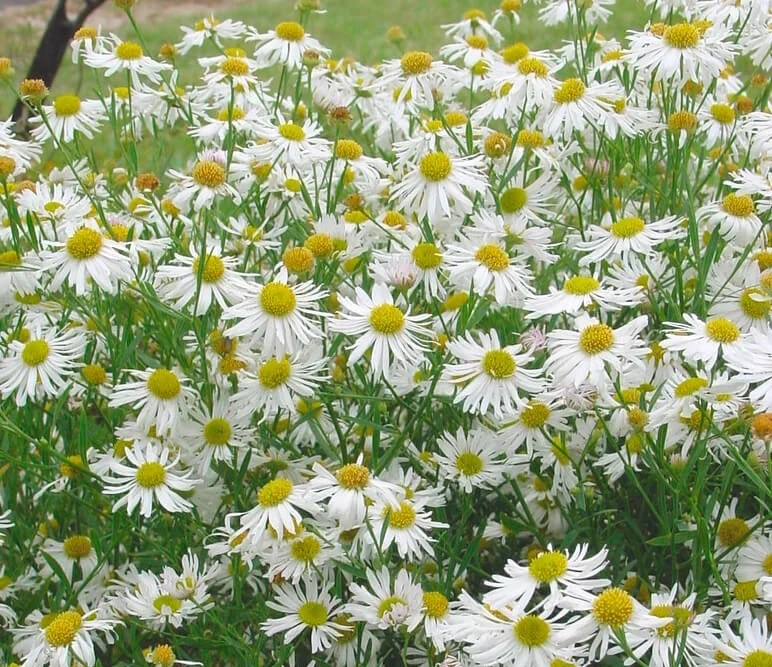
I looked out the window of my back door, noticing particularly a boltonia (Boltonia asteroides) blooming among a mass of New England asters. It had just come up a few years ago on the edge of a stone walk, and I had kept it, hoping that additional ones would grow inside the adjacent bed. None did, but the original one continued to grow and was now a good size with profuse white flowers. A second one had come up a short distance away in the stones under my clothes line, and I let this one grow with the intention of moving it after it was through blooming to a place closer to the first one and the asters. Now looking at that first one, I was conscious of it beckoning me to get on with the job.
What? I have written about my garden in several posts, describing how it is a living whole that includes me, for I have planted it and continuously care for it. In recent years there have been prolonged droughts, and I have kept the plants that needed it watered – even when there was mandatory water use restriction and I bailed out the gray water in my bathtub, carried pails of it down the stairs and through the house out to the yard. I take wilted leaves as cues to deliver water and drooping stalks as signals to install stakes, also splinting partially broken stalks.
Following Aristotle, I hold that artifacts’ forms are their use; for example, a chair is only a chair while someone is sitting in it and is just some wood or other material when unoccupied. Still, when I see a vacant chair I feel a subtle impulse to sit in it – to fulfill its essence. Similarly with my garden which is an artifact composed of living things: I give plants assistance in response to impulses I feel to aid them in fulfilling their lives. Such impulses are entirely inside me and only directed at the plants.
Now the boltonia is the agent and I am the patient. As I have repeated in several posts, the framework of our common understanding is an eternal present. We imagine that things function like clockwork – just continually repeating the same patterns. Yet Bergson has revealed to us that they preserve their pasts within them, and these condition, indeed literally create their ever-new successive present moments. I have added Bergson’s vital temporality to Aristotle’s essentialism to produce an interpretation of the universe in which things have manifold teleological essences and accumulate their pasts within themselves.
According to this scheme the boltonia is a living individual and a part of the whole garden and much else including being a part of the biosphere. Its body, which grows from the roots every spring and summer then dies back in the fall is the accumulation of all of the actions of its past preserved in an inactive state until reactivated, conjoining with external substances to create ever-new present manifestations of its life. Insofar as it is a part of the whole garden its past includes my past actions in it. Further, it has both an individual and collective telos: it strives to live and fulfill the nature of its species and the life of the garden. As an individual it seeks to spread itself and to multiply; as part of the garden it seeks to function in ways that serve both itself and the rest of it.
As I was preparing to write this post I came across a YouTube set in a lovely wild patch of New England asters and goldenrods. The narrator explains that they grow and bloom together, combining to optimize their attraction to bees to whom their colors are particularly visible. He says
Together, these two plant species have co-evolved to appeal to their favourite pollinators, and when these grow together, they have higher pollination rates that not only helps further their genetic success, but makes for more efficient pollen collection for the bees, which is a good thing for all others who depend on them. So in other words, these different flowers have evolved to work together along with the bees to create a system of mutual flourishing in which they all are able to thrive together, and in the process, these relationships create healthy, diverse ecosystems that allows all sorts of other non-human people to thrive, and knowing all of this just makes this pretty sight even prettier, don’t ya think?
My boltonia isn’t quite like a goldenrod, but it is a white native species blooming like New England asters in late summer. In fact in my garden it is continuing to flower while the asters are dying off, being the last of my native species still blooming in early October, thus extending the season for the insects who are now avidly collecting pollen from it. While the connection between asters and goldenrod is spatial, that between the former and boltonia is more temporal. For the latter continue the vital service performed by the asters when they are done.
Everything in my garden interacts with everything else with more or less mutual benefit, and as they are both native species that share natural habitats and perform complementary functions the relationship between the white and purple flowers is definitely more symbiotic than other relationships between species in the garden. The boltonia therefore likes the company of the asters and wants to multiply among them. Its action is the reactivation of motions from its past which, in its nature as part of the garden involve me. As all of its action is driven by the desire to advance its own life and that of the garden as a whole, it wants me to assist it.
We intuit the essences of living things which are their very lives driven by their desires. My intuition of the boltonia therefore includes its desires, among which are some directed at me. With my long experience in the garden and sympathy with it, I am receptive to this appeal.
I am a great admirer of Joe Brewer and his regenerative projects. As his communities, notably Barichari in Columbia, proceed to create self-sustaining ecological cultures practicing agro-forestry, natural features no doubt reach out to the people with guidance. While full earth regeneration requires a great deal of science that goes far beyond intuition, still the goal is life in which all the human and nonhuman elements serve each other for mutual benefit and make, as the YouTube narrator says, a pretty sight even prettier.

