Either/Or, Space/Time, Resonance/Presence
In the current polycrisis of escalating climate change, growing authoritarianism and increasing wealth inequality many people feel that there is little, if anything they can do to resist it, and together they compound each other’s despair. Their attitude reflects our culture’s definition of people as radical individuals that are parts of so many essentially mechanical systems, all obeying Newton’s First Law of Inertia. Yet now a growing number of thinkers are calling for system and worldview change, offering a variety of visions of regeneration, transformative adaptation and ecological civilization. A number of diverse efforts are presently underway to achieve these goals, and, as an issue and electoral organizer, I have considered and followed several of them, noting particularly their transience. We retain the Enlightenment’s conception of time as a series of discrete instants that are represented by points on distance/time graphs, and that era’s myth of progress adds to our excessive attention to the present and relative disregard for the past and future. Visionary plans or designs are frequently blueprints – representations of fixed structures that exist in the present and inadequately address how they are to be established and sustained, how they shall adapt to changing conditions and, above all, how they shall retain people’s engagement. The fact is that projects come and go all the time and so do their participants. As people wrestle with three-dimensional designs, prototypes, fractals and so forth, they fail to give adequate attention to the crucial fourth dimension – time. Insofar as this defect extends to the alternative worldviews they construct as well, my objective is to properly explain what time is and the place it occupies in our quest for a more ecological civilization. True understanding of time opens up infinite opportunities for people to individually and collectively improve the world now.
The present cultural attitude toward time is known as “presentism” or “nowism” which holds that the present is what is important, while the past is disdained and dismissed. Yet our cultural heritage is a gold mine; indeed past understanding is the material from which all present knowledge is constructed. So I bring back from the past some ideas and apply them to our present situation to create a new view and method of acting that serves our current needs. First I review the contrast Kierkegaard drew in Either/Or between momentary and enduring action which raises the matters of both temporal and spatial continuity of people’s lives. Next considering spatial relations, I proceed to the current attention to resonance and presence. In nature the latter is found to contain the past, and I continue with a summary of Henri Bergson’s doctrine of the retention of the past in the present. I then amend his system by developing its underlying essentialism which yields a full philosophy of nature that provides clear direction for action, the practice of which is illustrated by the work of Joe Brewer’s Earth Regenerators. As most people’s environments are urban or exurban habitats, their life action must be more of the nature of Rupert Read’s transformative adaptation. All life is in fact transformative adaptation, and with the proper intention, we can all constructively engage in it all the time, most effectively when we persistently work together.
Either/Or
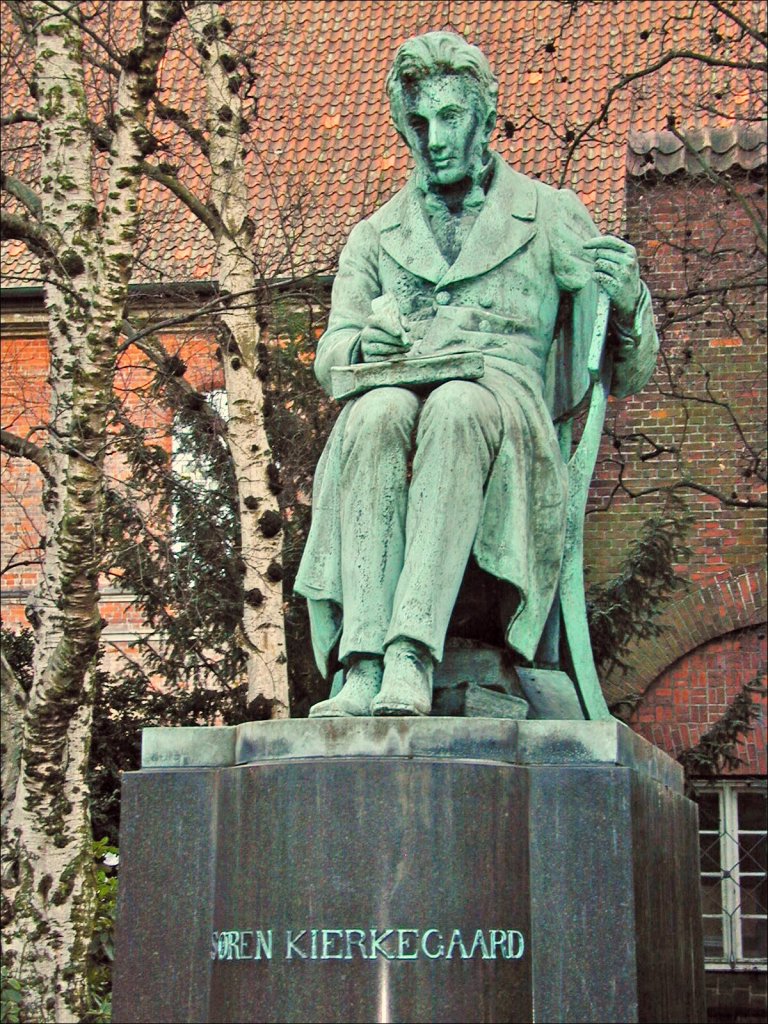
Soren Kierkegaard is best known as the father of existentialism who sought to mediate its radical view of human freedom with Christianity, presenting the case in the form of a letter published in his 1843 Either/Or. It is directed to a man who, according to him, lives the “aesthetic” as opposed to the “ethical” life. The former consists entirely of the pursuit of sensory pleasure and is epitomized by the character of Don Juan in Mozart’s opera, whom Kierkegaard calls a “sensual genius.” That legendary libertine is represented as having seduced a thousand and three women, with each of the acts having no antecedent or sequel; they are all like the supremely pleasurable and unique first love. These are therefore momentary experiences, unconnected to any preceding or following them, and the writer claims that the aesthetic life is such a series of disconnected moments saying to the recipient, “You exist in the instant.”1 It is thus distinguished from the ethical life, the primary relationship in which is marriage that embodies continuity, shared history and direction for the future.
While the aesthetic life is determined by things that are external to a person, the ethical life, Kierkegaard says, is directed internally by the continual exercise of one’s freedom. With any particular free choice one is also choosing freedom itself, placing themselves in the Absolute, the ultimate reality underlying particular things, contingency and sensory phenomena. This is the realm of universals, and, dwelling in it, a person’s actions exemplify universal ethics as revealed by their conscience. Moving through their life that is spatially and temporally continuous with the world and in which they perform a variety of functions involving family, work and civic life the ethical individual builds their history, that is, their character, and positively impacts the world. The ethical person’s acts, he says, are to be performed as duties the fulfillment of which gives them satisfaction. Above the aesthetic and ethical realms sits God, and the philosopher makes clear that in both humans are necessarily imperfect; in fact saying, “As against God we are always in the wrong.”2 So beyond aesthetics and ethics redemption consists in loving God and being loved by him in return.
Space/Time
Since Kierkegaard wrote existentialism has progressively shed religion while retaining its basic conceptions of individuality and nearly limitless human freedom. The aesthetic life Kierkegaard described is today the norm, with time divided into separate short periods, if not instants, as well as people living in ways spatially disconnected from other people, the places they inhabit and nature in general. A movement is now in progress to re-establish not only connection but actual, indeed organic unity, among the myriad broken pieces.
Resonance
Radical individualism is a tenacious idea, but some people are beginning to tackling it with the notion of “resonance” to describe how people approach and affect each other as well as some nonhuman things. The word means echo, which is sound reflected from some solid surface. So to say that one “resonates” with certain people or things is to say that those echo one’s own nature or reflect it some way that is colored by their nature, with the individual metaphorically functioning as both the transmitter and receiver of electronic signals. This representation of resonance reduces it to mechanical terms, but its function in organic processes is illustrated by bats’ echolocation whereby they emit high frequency sounds whose echo or reflection they hear as audible maps that guide their flight through caves. Common use of “resonance” however tends to refer to static rather than dynamic conditions.
Presence
The dominance of the spatial as opposed to the temporal perspective is also found in the current notion of “presence,” which is taken to mean being here, beside or near. Presence doesn’t necessarily imply things existing separately side-by-side but in a more diffuse manner as we say that someone’s presence was comforting or that it influenced a gathering. Such spatial continuity in nature is suggested by Thoreau’s observation
In swamps, where there is only here and there an ever-green tree amid the quaking moss and cranberry beds, the bareness does not suggest poverty. The single-spruce, which I had hardly noticed in gardens, attracts me in such places, and now first I understand why men try to make them grow about their houses. But though there may be very perfect specimens in front-yard plots, their beauty is for the most part ineffectual there, for there is no such assurance of kindred wealth beneath and around them, to make them show to advantage.3
In addition to breadth, this presence also has depth, as he says
Art can never match the luxury and superfluity of Nature. In the former all is seen; it cannot afford concealed wealth, and is niggardly in comparison; but Nature, even when she is scant and thin outwardly, satisfies us still by the assurance of a certain generosity at the roots.4
While such presence for Thoreau was also basically spatial and therefore static, Aldo Leopold, who had an intimate awareness of nature, captured the dynamic aspect of presence in his Sand County Almanac entry “Thinking Like a Mountain.”5 When wolves inhabit a landscape he says, their presence conditions all other things including the vegetation which is protected by them keeping the deer population in check. Their howl fills the night, as every potential prey animal is ever on alert to sights, sounds, scents and signs of their approach. The lives of wolves not only intersect with the lives of things around them, they deeply interpenetrate them, as these apex predators may be said to live into the whole place.
Still, being present is persistently understood to be in the present – the present time – as people are admonished to refrain from directing their attention to the future instead of the present. Though “Thinking Like a Mountain” is about presence in the ever-renewed present over the course of time, Leopold offers subtle insight into the presence of the past in his entry “Good Oak.” There he describes how he and some friends sawed up a one hundred-year-old oak tree near his farm that had blown down in a storm. They cut it by hand, progressively sawing into the rings of the trunk that were historical records of not only the tree itself but also the place, for the tree was present in the place as, conversely the place was present in it.
Apparently not explicitly aware of such truth, Leopold implies that the tree’s rings aren’t just records of the past; they are the past preserved in the ever-renewed present. This is no idle thought, for I am personally conscious of past time preserved in big trees. Indeed, a tree is a living heritage, and this is why the destruction of trees symbolizes the annihilation of certain heritages or pasts. Examples of this are the fall of Yggdrasil which marked the end of the world ruled by the Norse gods and the destruction of the cherry orchard in Chekhov’s play that symbolized the end of the whole feudal order in Russia. While big old trees, forests and orchards are particularly striking instances, all plants, all organisms and all of nature are living heritages as well.
Becoming
My discussion so far has illuminated how in our common understanding and practice space and time are discontinuous: sensory experience, while not instantaneous, is taken to be a series of moments whose content may be some reflection of ourselves, and although we consider all objects to be separate and distinct, we in fact have an obscure sense of their extended presence. We are also dimly aware of the preservation of the past in certain things, notably big old trees, but find that incomprehensible. Bringing Kierkegaard’s Either/Or to bear on these matters may seem arcane, however it was he who formulated the notion of existential freedom, and the issue of freedom remains central in our lives.
I have written extensively about the human action that is needed now to turn away from the status quo and address the polycrisis, drawing much inspiration from the early twentieth century French philosopher Henri Bergson whose work focused on time. I don’t think anyone will deny that his work is difficult to understand, but the effort to do so is definitely worthwhile and is something in which I have been engaged for several decades. Recently I published The Timely Wisdom of Henri Bergson in which I attempted to present a full account of his philosophy with some amendments of my own. He unequivocally states that material objects repeat the past in the present, but while I correctly followed him in stating that the present is continually created, I mistakenly claimed that the past is recreated in every present moment. After I completed the article I was dogged by the conviction, based on personal direct experience, that the past is literally preserved and present in big old trees. Reflecting on his ideas I finally understood the subtle truth that he reveals, and I am writing this article to correct my error and amplify projects going on now that embody my philosophy of action to meet today’s urgent challenges.
As Bergson asserts, the universe Becomes, and the absolute Becoming of things is well illustrated by the life of a plant which temporally extends its existence into each successive present moment while also spatially extending itself with new growth such as the addition of rings to a tree’s trunk. Each year a tree grows a new ring at its circumference as the inner rings no longer grow but form its substance or matter within which fluids continue to flow.
Among the variety of terms that Bergson uses to describe the past the one that applies here is “inactive,” and to illustrate the difference between active and inactive I move to the human body. I learn a dance step in the present moment which passes away into the past. Then at a later time I repeat that step which had passed from activity into inactivity and was preserved in that inactive or dormant state in my body until I re-activated it. Of course the body is alive and remains active in many ways, but not with respect to the dance step while it is inactive. Similarly with the tree rings: in its first year a ring grows, then that growth ceases and becomes its past or a ring that no longer grows.
In Becoming a thing perpetuates itself, which includes both its active and inactive functions, into each successive present moment. Simply distinguishing present and past as active and inactive makes the difference one of degree that only becomes significant when it is seen how the past continuously re-enters the present either as bodily habits or conscious memory images. Habitual bodily functions represent the reactivation of motions that continually pass away into the past, for example, the motions of walking which are inactive or dormant when we are sitting.
Bergson defines the body as one center of action among others in a continuous universe where they all interpenetrate each other. In Becoming they mostly repeat their pasts, and this constitutes their materiality, for however far we go in reducing “material” things, we will never reach anything permanent. As Heraclitus said, “Panta rhei.”
So the universe is a multitude of actions, among which some are ever-new as they continually Become while others repeat in every successive present moment their previous actions in dormant states which are their pasts in their pastness. Dormant actions are not inert, for they may be reactivated, and this is especially evident in animal life.
The primitive animal, the amoeba, is a collection of habits for which touching an external object is an elementary sensory experience that activates a particular one. While inactive these habits constitute its past from out of which the selected habit re-enters the present immediately, since the amoeba has no advance notice of the object’s proximity. That is precisely what more advanced forms of perception provide: we see, hear and smell things located at a distance from our bodies, and these senses enable us to prepare – to choose which habits we activate in response to them.
Within the Becoming universe particular things are centers from which action radiates, with all interpenetrating all. This action exhibits varying degrees as, for example, the difference between the physical action of the body and actions that lie dormant within it. As a seeing, hearing and smelling subject, the body radiates – to be exact, projects – habitual actions in a virtual state onto the objects around it. These are potential actions determined by its intention at the present moment that Bergson says are reflected from those objects in the form of images which represent the body’s potential action upon them. As a multitude of objects surround the body, these images represent a plurality of possible actions from among which the subject can choose to actualize one. In short, perception is a preview of bodily memories which the body can re-activate in the given situation as they apply to the objects at hand. Although this is a very unusual interpretation of sense perception, it is true. Our visual images are literally located outside the image of our body and they indicate what our body can do to the objects so represented – where we can touch or grasp them and how far it must move to make contact with them.
So far I have faithfully followed Bergson’s position, but now I proceed with my own amendments to it. For him, the “pure perception” I have just described isn’t conscious, and it only becomes so when image memories, which he equivocally says in Matter and Memory are stored away in a separate spiritual realm, come forth to overlay and merge with it. Conscious perception therefore becomes like cinematography, consisting of a rapid series of still images.
He takes this view not only to explain consciousness as a spiritual phenomenon, but also to resolve some challenging issues with perception itself. The universe is a spatial continuum with things being qualitatively different but not distinct, so how is it that we see countless discrete objects? Further, while the world isn’t entirely in rapid flux, there is continual change, so where do we get the sense that anything is permanent and unchanging?
Using the analogy of energy physics Bergson has the process of perception contracting light’s high frequency or very short moments of duration into the body’s longer moments of duration, thereby producing perceptions of colors. He also comes very close to identifying matter with low-frequency and consciousness with high frequency energy, with the latter approaching, and at the extreme passing into, spirit. While this analogy with scientific theory conflicts with his position that science is a conceptual construction and that only Becoming is real, there is truth in his concept of “rhythms of duration.” Matter can certainly be understood as repeated past actions, and nature does seem to be universally cyclic, with different cycles simultaneously going on at different rates. The human body clearly illustrates this with its various rhythms or cycles of blood circulation, respiration, digestion, reproduction, sleep and waking, and these are correlated with terrestrial and planetary cycles such as the earth’s rotation and lunar revolution. While these latter are invariable, some of the body’s rhythms vary, as our breathing and heartbeat speed up with exertion. So although rhythms of duration certainly exist, they can’t be exactly determined.
Perception does in fact contract the spatial and temporal continuity of things into discrete, somewhat constant images, and this, I say, is due to the projection of virtual bodily memories onto external objects that produce sensory images. For Bergson such images are reflections from these objects, and he compares them to mirages in which light reflected from clouds produces images of water on the ground – a phenomenon reducible to the physical natures of light, clouds and bare ground.
In the Becoming universe things are not physical entities but particular configurations of the universal life, and in perceiving something the body forms a functional conjunction with it that produces the image. Like moving its limbs, consciousness is a function of the body, and although it is different from such motion, the two exist on a continuum in which consciousness can pass into motion and vice versa. This is seen in the passage of virtual action into images and images into physical action.
Thus I, a seeing subject, approach a visible object with a certain intention, and in these capacities we functionally conjoin and, doing so, form an image. As this image is an extension of my life, it is also one of the object’s, and we are literally united in it. It forms from my projection of certain bodily memories in a virtual state subject to my present intention, so it represents a particular search to which the object responds by presenting its qualities relevant to that search. For example, I want to walk down the street and look ahead of me with that intention. The street for its part contributes to the image a view of itself as a fairly homogenous level surface from the perspective of my body. If, on the other hand, I drop a coin on the street and look to pick it up, I see a pebbled gray surface upon which the coin might stand out as a silver disc. In general, we see what we want to see and the aspect in which we want to see it.
The conjunction of virtual actions or bodily memories in a virtual state with external objects further effects a contraction of otherwise indistinct and impermanent qualities into distinct and more stable images. A sphere of consciousness exists around our bodies, and it is a zone of contraction, reduction and intensification of life energy, commonly known as attention. The contents of images are certain functional conjunctions of the subject’s virtual action, determined by their intention, and the object’s nature. Seeing an object at a distance entails a delay in a bodily response, and in the interval, one focuses their attention upon it. This means not only sustaining, that is, continuously repeating, the projection of the particular virtual action, but also, as Bergson explains, having further memories come forth that illuminate sensory details in the object and bring past experience to bear on the choice for present action. I don’t just examine the object, but I review what is likely to follow if I choose this or that move, in other words, preview the effect.
The philosopher is absolutely correct to say that memories crowd into present perceptions but, as he has intact and discrete memory images coming forth from their separate spiritual abode, this means that, although they are re-activated by merging with present perceptions the process is discontinuous, thus producing the cinematographic effect. In reality memories re-enter the present as virtual actions in the way that I have just described for the purpose of producing perceptions of external objects.
We can, of course, form memory images separately from external perception. The latter consists of virtual physical actions conjoined with the natures of external objects which, like actual physical motions, pass away from the present into the past and are preserved in an inactive state as the body continuously repeats its past while otherwise Becoming anew at every successive present moment. Therefore, like bodily movements, such preserved perceptions can be re-activated. If the previous external object is present, the virtual action projected at it is the particular past one, and the actual perception that is formed is one of recognition. If that object is absent the past image must be re-activated by itself and therefore appears substantially reduced and held in consciousness by heightened attention.
So the body is a collection of preserved habits that are selectively projected as virtual actions onto objects in its environment over the course of its continuous Becoming. First conjoining with those objects to form images, chosen virtual actions proceed to become actualized in ever-new present moments.
Along with sense perception Bergson recognizes the conscious function of intuition. His earlier writing describes it as immediate consciousness of Becoming – a very relaxed state of mind in which qualities appear indistinct, continually come into being in the present and flow away into the past while memories appear, interpenetrating the present. This intuition, he says, is directly knowing Becoming as oneself Becomes. While Matter and Memory constructs memory and perception entirely from sensory experience, he later in Creative Evolution adds an intuitive component to it. Sense perceptions, he says, form the nuclei of experiences in which intuitions of objects form the fringe and through which we might directly enter into those objects in acts of sympathy.
Also in that work he asserts that evolution has diverged into the two pathways of instinct and intelligence exemplified by the amoeba and humans. The former, as I have indicated, is barely conscious, reacting automatically to sensory stimulation. Human intelligence is focused on the materiality of things, much of which it constructs itself by overlaying the immediate flowing content of its consciousness with still memory images. This process, Bergson says, “spatializes” time by appearing to lay out unchanging objects side-by-side in an homogenous space. An intelligent being is particularly adapted to working with inorganic substances and making tools to facilitate that work, while the amoeba’s life is confined to continually repeating its past, functioning at only a slightly higher level than a rock. Humans escape such inertia with faculties that permit them to choose among alternative courses of action, and their freedom is exponentially increased by their further power of contracting images into ideas and technology. All this represents so much contraction or intensification of the natural flow of Becoming evident in the immediate intuition of it. Presumably the intuition existing on the fringes of sense perceptions is immediate consciousness of the Becoming of their objects.
Although Bergson has everything being spatially continuous, interpenetrating and flowing into each other, he does have the body being a center of action with a highly complex anatomical structure that demarcates interior and exterior. Also, as in Creative Evolution he acknowledges co-evolution, symbiosis and the unity of populations of some species such as bees, he clearly recognizes the individuality of things which is nothing other than their essences. He is a vitalist, and the objects in his universe are precisely Aristotle’s essences to which have been added full ecological and temporal natures.
They are alive in a total living universe composed of innumerable intersecting and nested whole lives. This means that their lives are manifold: they have multiple identities as individuals and as parts of so many larger wholes. Try as he might, Bergson can’t avoid teleology, for organisms are obviously moved to remain alive and to proceed through the stages of life from infancy to adulthood. For him the goal of evolution is ever-greater freedom from entropy and inertia, but this notion is outdated, as we now accept the basic Gaia conception, and man’s freedom has landed us in today’s likely catastrophic polycrisis.
All the lives in the universe, up and down the chain of being, are essences with their own final causes, both insofar as they are wholes and parts. Accordingly, as an individual, my purpose is to live and to perform my essential functions, while also, as a part of nature, my purpose is to serve it, and likewise with respect to every whole of which I am a part. Though nonhumans do this automatically, humans are unique in possessing free will and are therefore at liberty to decline to function in any or all of these capacities.
I have repeatedly advocated for people to fully live by acting to the best of their ability in all of their identities, but what exactly does this entail and how does time figure in the plan? After briefly mentioning the intuition that accompanies sense perception, Bergson does not pursue the prospect of entering into the Becoming of things through it except in his final book to propose a major exploration of spirituality. We need not look into an after-life, because our experience already abounds with intuitions of the essences of things. Sense perception presents us with colors, shapes, sounds, sensations and so forth, but alongside these effects, we are immediately aware what things are. Thus, I am aware of the very life of my cat, which is distinct from her color and shape and has the quality of “catness.” Like my visual image of her, my intuition is located in the space of my experience, outside the image of my body and approximately where the cat is located. Bergson says that entering into the Becoming of things requires “sympathy,” and intuiting my cat’s very life requires, at a minimum, an interest in that life. The aspects of things that we perceive with our senses are determined by our intentions, and the same is true when it comes to intuiting their essences: I just consider the shapes and colors of things because I want to, and I similarly intuit their essences with an attitude of sympathy. For in sense perception I functionally conjoin with the object insofar as it is sensible, giving rise to the sensory image, while, intuiting it I functionally conjoin with its very life, with this act producing the intuition. Conscious of its life, I care for my cat by feeding it, giving it comfort and affection.
I in fact have two cats, so I perform these actions for both of them – providing sufficient food and water, space on the bed and tracking their coming into and going out of the house. Some people have multiple species of pets, so they perform different actions that are determined by the animals’ different natures. The variation of action increases with the variety of animals which might include a number of domestic kinds such as chickens and cows. Keeping farm animals requires structures such as chicken coops and barns as well as fenced pastures, so the care becomes not only diverse but also complex. The care giver’s life becomes more integrated into those of the animals, so the farmer lives on the farm and works full time to maintain the lives of the animals, the crops and the property. They no longer “enter into” this thing and that separately but rather “live into” the whole set-up. Because the farm constitutes the farmer’s livelihood, they care for its life as they care for their own body. Such care is an obligation for their life – a duty – as Kierkegaard would say, which is guided by their intuition or conscience.
Bergson’s model of sense perception also applies to intuition: it originates with the virtual projection of a bodily memory determined by a particular intention. And although the intuitive component may be minimized, sense perceptions and intuitions are in fact inseparable. Our attention may be focused on the sensory qualities of certain things, but we’re always normally aware of what things are and do not regard them solely as sensible phenomena. We may in fact perform this last action in previewing a scene for a photograph or painting, looking at it as a two-dimensional collection of colors and shapes, but this is a distinct departure from normal perception.
Still, in our modern life that is largely removed from nature, our experience is dominated by its sensory aspect, and we must make a special effort to bring intuition to the fore. People do normally “live into” their homes – interacting with family members at least in this identity if not as full human beings and making appropriate use of the house and the other artifacts that it contains. Homes and family have important aesthetic aspects as well; people endeavor to make the house and themselves attractive to the eyes, flesh, ears and nose and particularly the food pleasant to taste. Yards are considered primarily in regard to the appearance they present, especially visual, but also tactile as affording shade from trees and olfactory in providing fragrance from flowers. People live into their yards by mowing their lawns and tending flowers and vegetable plants, but they do this chiefly for the purpose of maintaining the appearance and producing extremely hybridized, if not GMO food.
As I project my life into the environment in the form of virtual actions with particular intentions that arise from bodily memories, the objects around me are doing the same, although their memories and intentions are unknown to us. My dual projections conjoin in my sensory image and intuition of the object, both of which indicate my potential action upon it. I may wish to just behold the life of a tree, a flower or my cat, and I savor the intuition of their essence. Or, as I notice that that a flower has wilted, this arouses my bodily memory of giving it water, so I proceed to fill the can and pour some on it. Alternatively I may take note of the current high temperature and decide that the wilt is due to the heat and decline to water the plant then. I may also look at my Siberian irises and note that only a few have buds then consider how they are shaded by a nearby bush which I proceed to trim to give the iris more sun. This is living into things that seeks to simultaneously serve the interests of both the objects and myself.
In our present culture humans seek their own interests, regarding nature as a resource and other people as instruments for satisfying those interests, and this is acting strictly in one’s identity as an individual human being. Yet our escalating environmental crisis demands that we act in all of our identities – as individuals, members of communities and parts of all the intersecting and nested whole lives that constitute the universe. Such a life entails a specific attitude which is the desire for the ideal represented in the vision of global regeneration or the ecological civilization. This desire is our full natural telos, and the vision is an internal image constructed in imagination from written and visual sources.
Central to my thinking are essences which are Aristotle’s to which I have added an ecological dimension that incorporates their relations and recognizes a multitude of collective essences that form organic wholes. My focus has therefore been on things rather than the functions or processes that compose those things. Now however there is a model for not just experiencing the ecological nature of things but living into their interconnected lives with regenerative action.
A very basic example of living into a natural situation is provided by Aldo Leopold’s account of a fishing experience in “The Alder Fork: A Fishing Idyll.”7 As I noted above, he had a keen intuitive awareness of natural things, so arriving on a stream bank and finding no fish in the water there, he inferred that on such a warm day they would swim upstream to where it was cooler. Moving to a pool surrounded by dense vegetation he first carefully studied the fish he found there, the sunlight playing on the water and the breeze rippling its surface. Instinctively he cast at just the right moment and caught the fish, leaving him with the sublime sense that every element of the time and the place conjoined perfectly to bring his effort to fulfillment. The episode was an extended present moment in which Leopold’s past experience that constituted some measure of fishing expertise came forth to literally determine precisely what he saw and intuited as it guided his movements.
Joe Brewer with his Earth Regenerators project takes living into nature to a whole new level, selecting bioregions as primary units and focusing on the natural relations of things to establish fully ecological human communities. Like Leopold, he has a deeply intuitive awareness of natural things backed by vast scientific understanding of systems. He distinguishes these two modes of knowledge, invoking the terms “sacred,” “kinship” and “Gaia” to describe the former as he emphasizes that the map is not the territory, thus admitting that systems theory is a tool or a model that does not represent the ultimate nature of reality. This is like engineers using classical mechanics as a tool to construct things but never imagining that the world is just a machine as some early modern physicists did. While the application of systems theory to biological phenomena has benefits, there is also truth in Thoreau’s observation regarding the luxury, superfluity and concealed wealth of Nature. Further, as Francis Bacon wrote, science puts nature on the rack to extract its secrets, but when we enter into it with sympathy, á la Bergson, she willfully reveals them and presents her gifts to us.
Brewer has a vision of a regenerated earth, and this is the ideal that drives his life. The principal feature of bioregions is their water, so he focuses particularly on restoring water resources, presenting some of his projects on You Tubes. He is a most inspiring embodiment of Gaia, sharing how, for example, finding a stream degraded, he used his hands and shovel to dig a series of retention ponds from which water would infiltrate the ground to promote regeneration of the soil and vegetation. In this video he expresses delight at the lavish growth of mushrooms on a log he had placed beside one. Another video is about collecting rocks and placing them in the bed of a stream to retard its flow, an activity that he says anyone can do to help watershed regeneration. His attention to relations among things is illustrated in this video entitled “Listening into the Birth of Rivers” in which he points out the fibers on a certain plant upon which atmospheric moisture condenses to then make its way to the ground where mosses grow and finally drain into crystal clear pools on a fairly arid mountain top.
The village of Barichara, Columbia where he lived embarked on creating a food forest to achieve the goal of full ecological self-sufficiency while the people aim to live congenially with each other in this intended ecological niche. Their ultimate objective is to restore the Barichara bioregion and they have identified stages in the process while allowing for unforeseen developments. Brewer uses this project as a model for creating bioregional learning centers in other locations around the world and conducts trainings in the village for people coming from many countries to become immersed in its regenerative culture.
With immense scientific evidence Brewer asserts that the future of humanity depends on shifting from our present mode of existence to bioregional regeneration. He is being remarkably successful in expanding his project globally, but is still realistic, urging people to become informed, organize and engage in regenerative practices as much as they can where they are. Although political challenges are increasing, he maintains Earth Regenerators’ independence from politics. I fully support this endeavor but, as he is no doubt aware as well, the current political situation is dire, posing a different threat of a magnitude comparable to that of climate change. As useful as science is to Brewer, it notoriously fails to deal with human free will, and attempting to impose Indigenous customs on contemporary urbanized folk is fairly futile.
In this urgent moment one prominent leader tackling climate change in the public arena is Rupert Read with his Climate Majority Project. Having been very active with Extinction Rebellion he came to the conclusion that while the majority of people in the U.K. were concerned about climate change, making a significant impact required that this majority become active. His movement targets people in all sectors, striving to “meet them where they are,” since they are generally resistant to change in the ways they live and business as usual. It initially prioritized telling the truth about climate change to the public, underscoring how serious and immediate its effects are. Then in 2024 it advanced a vision of “transformative adaptation” whereby people work together to modify their communities in an array of ways that address present impacts and prepare for inevitable future ones while also bringing about system change. Most recently it has launched the S.A.F.E.R. Strategic Adaptation for Emergency Resilience Project that adds to transformative adaptation a full spectrum of immediate and long-term actions that all sectors must take to avert climate catastrophe. Stressing that to fail to prepare is to prepare to fail, it further reaches out to businesses, educators and governments to support integrated change.
S.A.F.E.R. especially advocates climate adaptation activities in local communities directed at such impacts as flooding and extreme heat which not only bring the crisis to people’s immediate attention but engage them in responding to it. By this means people no longer feel overwhelmed and powerless as they further develop the social cohesion and trust necessary for resilience. The latter requires communities to re-localize economic activity particularly with food production and to advance robust democratic participation. Read himself persistently disseminates climate change news that his government wishes to suppress and leads a push for bold national government action.
Although it is degraded, the natural material or environment upon which Brewer works is receptive to his activity. He asserts that nature has an essentially regenerative character, so using well-founded methods he successfully assists, accelerates and amplifies such natural processes, calling this activity living into Gaia from which he derives great satisfaction and joy. While making his presentations he radiates vitality and passion for his mission that inspire his audience to share in it.
He accepts the scientific understanding that projects system-wide collapse from unchecked climate change with the accompanying environmental degradation and recognizes the systems theory phenomenon of “phase shift.” By this, it is claimed, systems that have become unstable but within which “islands of coherence” have formed undergo total transformation to a higher order. As Brewer seeks complete system change, he foresees his vision inevitably coming as such a phase shift.
Read, meanwhile, confronts the civilized world as it is. As he previously fought an uphill battle to tell the truth about climate change to the public, the facts are now forcefully on display in a pattern of unusual heatwaves, flooding and wildfires in Europe. The U.S. and Canda are suffering these effects plus persistent drought in many areas. There can be no denying that climate change is now upon us with a vengeance, so his challenge is to mobilize communities, businesses, institutions and governments to adapt to it for both the short and long terms.
This article affirms individual human autonomy and free will, both of which are denied by systems theory. I am also conscious of historical examples of cultures ending and changing, notably the Roman Empire, and therefore believe that happy endings are by no means assured. In activist circles we are repeatedly reminded that no calvary is coming and that everything depends on us. Collective action is absolutely essential, but the truth is that collectives are composed of individuals who have the ultimate choice of how they act. Indeed, Kierkegaard said, “A crowd in its very concept is the untruth, by reason of the fact that it renders the individual completely impenitent and irresponsible, or at least weakens his sense of responsibility by reducing it to a fraction.”8
So we go back to Kierkegaard who affirmed the individual’s absolute freedom apart from momentary sensory phenomena. Bergson also affirms freedom to choose among potential actions presented in sensory images. As we pursued the latter’s intuition of things obscurely described as accompanying such images, we arrived at my ecological essentialism. It accepts the conception of Gaia, emphasizing that humans form organic parts of both it and so many other intersecting and nested whole lives. In addition, humans possess freedom to choose particular actions and the identities in which they perform those actions. As Kierkegaard’s free ethical individual dwells in the Absolute and is guided there by their conscience, so the freest agent in my philosophy is the one who acts primarily in their capacity as a part of nature, where their identity and action are the least limited. Brewer exemplifies such agency, since as he intuits the essential natures of things in light of his expertise, he literally engages those natures in support of his regenerative actions. This method is even seen in how he recruits people to join him as Earth Regenerators.
For the Danish philosopher, every action entails an either/or choice, which is actually more of an either/or/or/or… choice among multiple options. The ultimate choice, however, is the choice to act freely at all – to dwell in the Absolute, universal or ethical realm or the sensuous aesthetic one. A similar choice is posed by ecological essentialism – do we prioritize our intuitions of essences – to life and lives – or sensory images, for normal experience always includes both. Choosing to dwell in life by focusing our attention on intuitions of essences and to act primarily in our natures as parts of nature as a whole contrasts profoundly with the usual preferences for sense perceptions and action in our identities as individual persons. The latter choice is for atomization of everything, not only oneself and their agency but also, as Kierkegaard stressed, the time of their lives which is broken into a succession of unextended instants that form neither past histories nor courses for the future. Regeneration, as is evident in Brewer’s activity, is eminently continuous, cumulative and progressive, aimed at the ecological ideal. He understands the pasts of places and peoples as heritages and their futures as missions for the present generation to fulfill, especially for the sake of their children.
Either in a more natural setting such as Barichara or in the U.K. today where Read operates, regenerative actions constitute transformative adaptation. For, as we learn from Bergson, our motions functionally conjoin us with external objects as these joint actions literally Become in every successive present moment. Becoming past these actions are repeated within the universal Becoming, thus constituting matter. Repetition is inertia – staying the same and collecting present moments into the past – as illustrated by the ongoing life of our bodies. Transformative adaptation, on the other hand, is change – literal co-creation of each successive novel present moment with action that ripples throughout the universe but is not necessarily regenerative. Action that is regenerative is both driven by the right intention and is well-informed for that purpose.
Like all modern science, systems theory denies teleology. It says that life self-organizes itself, but to what end? While humans are seen to form mobs, armies and regimes to murder and destroy life on ever-greater scales, this is due to their freedom to decline to act in their natures as parts of communities and nature as a whole to serve the lives of those collectives, which, by nature, they do. Choosing to act as a part of nature, we are moved to act in its interest, and gaining the right understanding and holding the ideal in our minds, we act as Brewer does, living into Gaia.
Being a full-fledged Earth Regenerator is not an option for most people who must therefore follow Read’s method of transformative adaptation on both the local community and national political levels. Brewer has a plan for governance with local, regional and global structures that exist alongside and ultimately in place of the existing ones with which we now must contend. Governance and civic engagement are natural human functions, indeed, as I follow Aristotle in holding that they are our highest functions and potential expressions of freedom. S.A.F.E.T.Y. relies heavily on public policy and funding as well as robust civic engagement, so it operates to a very great extent within human culture, not raw nature. Not only are people free to decline to act in accordance with their full ecological natures, presently their action has a primarily cultural, not natural, character. As we are surrounded by man-made things – artifacts – our activities are mostly artificial – artifacts as well. So there is no question of “living into” the civilized human world as we may “live into” nature. As form is function, we do intuit the essences of artifacts which are fabricated to serve human interests at the expense of nature and often to its detriment, so their use must be assessed according to the universal perspective. Still, it is true that man is, as Aristotle said, “by nature a political animal” and a rational animal to boot. So our living universally must involve considerable exercise of our civic natures to achieve universal objectives.
So here we are, facing the greatest threat ever to human survival. What do we do? For Bergson we are creatures of habit: most of the time we act automatically, repeating past actions without pausing to consider alternatives and when we do choose it’s typically between routines. For example, looking up at the sky, I decide whether or not to carry my umbrella when I go outside. But giving my attention to the lives of things – intuiting those lives or essences, holding the ideal of Gaia or the ecological civilization and accumulating experience, including much in the civic arena directed at achieving that ideal, I see opportunities everywhere. This is like Brewer seeing an eroded stream bed as an opportunity for him to restore it.
As our present actions pass away into the past their effects remain as repetitions of that past, so progressive change is iterative; the effort must be sustained. Once and done action is little better than no action at all. In the spirit of Kierkegaard, it’s like reducing marriage, which essentially extends over a long time, to the short period of the wedding ceremony or even the moment of the kiss. Living into nature, as Brewer makes clear, involves a commitment to a place, the plants, animals and people in it, indeed identifying with its ongoing life. It is to be noted that marriage is an institution, a cultural artifact, so the transformative adaptation we seek can admit institutional elements so long as they serve its purpose. Indeed, practices that are found to be effective need to become customary but not hidebound. The first point I therefore want to stress is that our action must be continuous, with a well-planned beginning, intermediate stages and end plus provision for unforeseen developments. This last component requires continual evaluation that determines what’s working and what’s not, for life is change that in our highly degraded condition is increasingly unpredictable.
My second point is that our activity must have depth, as Brewer addresses the virtually infinite complexity of things’ lives and Thoreau sees the extension of the spruce’s life into the marsh. Our sense of resonance is genuine, for in perception and intuition the essences of external objects literally conjoin with our own, and presence involves not only a plethora of qualities and interrelationships but also, as we have seen, fabulously rich histories. Truly engaging people, as both Brewer and Read recognize, is living into their communities. Single-issue organizations and campaigns are so unsatisfying compared to the multi-dimensional communities that people crave. Establishing these is extremely challenging, as Transition Towns has found, but people can start by developing multi-dimensional relationships with each other and even connecting with neighbors in communities that are already multi-dimensional to some, albeit small, degree.
The goals I have identified aren’t a pipe dream but have been significantly realized before as, for example, the fairly whole community created by Grace Lee and James Boggs in the 1970s in Detroit and, more recently, the solidarity and mutual aid established in response to the murder of George Floyd and continued through the ICE surge in Minneapolis. Folks in many communities are also now uniting to oppose data center developments in them. Because data centers pose so many threats – to water and electricity supplies, air and noise pollution, destruction of farm and forest lands, massive job loss and surveillance plus subversion of democracy – they present excellent opportunities to raise public consciousness and engagement on the interconnection of all these issues. Indeed data centers are awakening people’s essential faculty of practical reasoning which for Aristotle was the ability to identify the right measure in matters of choice. Increasingly people are saying, as Bernie Sanders has often repeated, “Enough is enough.”
The world as we have known it throughout our lifetimes is ending fast, with rapidly escalating climate change, environmental degradation and authoritarianism that impact everyone. I have offered two organizing models that target the whole political economic system, which contrast with the multitude of narrow campaigns that only tinker around its edges. These take needed whole-system approaches that ultimately require the participation of the majority of the population, so what is a lone individual to do now? If they are able, they should join Earth Regenerators or the Climate Majority Project, but if they are not, especially if they live in a place that is simply not amenable to either of them, they still have considerable opportunity to engage in regeneration of the earth and democracy and positive transformative adaptation. Shifting to primarily intuitive consciousness and acquiring relevant knowledge and experience, one can effectively perform the simple actions of conserving resources, converting lawns to gardens with native species including trees and participating in issue and electoral campaigns for conservation and democracy, above all, persisting in these efforts. It is imperative that we also share with other people our comprehensive outlook, what needs to be done and is currently being done, identifying hooks or angles for getting them engaged as well.
Working together with others for one common purpose is wonderful, but the time has come to shift from very limited objectives to full-spectrum action. By nature our perspective is total; we desire a good life and a good world, and we are free to the extent that we seek and achieve these goals. Joe Brewer frequently speaks of the joyful feeling of regenerative action which aligns with Robin Wall Kimmer’s observation that as we love nature, it loves us in return. For Kierkegaard man’s ultimate benefit was loving and being loved by God. Living into nature we feel its love, and for people of traditional faith, this is an added bonus. In any case it is a vital obligation with a large component of civic duty, and while it is now the greatest one that humans have ever known, it is also the greatest opportunity for people to act as free living agents.
NOTES
- Soren Kierkegaard, Either/Or Vol. II, trans. Walter Lowrie, (Garden City, NY: Doubleday & Company, 1959), 205.
- Ibid., 348.
- Henry David Thoreau, A Week on the Concord and Merrimac Rivers, (New York: Thomas Crowell Co., 1911), 397-98.
- Ibid., 397.
- Aldo Leopold, A Sand County Almanac with Essays on Conservation from Round River, (New York: Ballantine Books, 1970), 137-141.
- Ibid., 6-19.
- Ibid., 40-43.
- Kierkegaard, “The Point of View for My Work as an Author” in The Point of View Etc., trans. Walter Lowrie, (London: Oxford University Press, 1939), 114.

