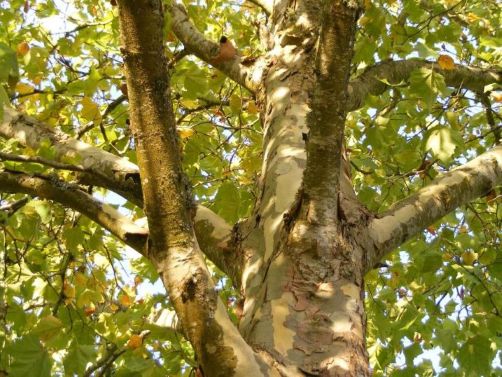
Thirty-three years ago I planted a sycamore tree in my front yard. It had since grown to around seventy feet tall and close to, even touching, the front of the house as it presented an enchanting view from my bedroom window. Sitting on my chair to put my shoes on every day I would gaze at the dense, diversely illuminated foliage moving gently in the breeze that formed a sublime aesthetic composition and brought to my mind Thoreau’s remark
Art can never match the luxury and superfluity of Nature.1
Along with the visual image I was conscious of the tree’s manifold life with its multitude of individual leaves that lived with and for each other. Previously I have written of “dwelling” in life and “living into” natural things, and these are forms of inclusion in the lives of things around us. In the case of the sycamore, my living into it was a special part of my living into my home and yard, the whole back of which is a flower garden about which I have written several posts. So I would dwell in the sycamore’s life, feeling enveloped and sheltered in its leafy splendor.
I didn’t just one day stick the sapling in the ground and leave it alone. Early on I kept it watered but soon discovered a small branch going bare and then dying. After several seasons I determined that it was infected with anthracnose, an incurable fungal disease, thus for many years I have had the trunk injected with a substance that minimizes the damage. Having so cared for the tree I am conscious of its gratitude, as Robin Wall Kimmerer has put it, that as I love it, it loves me. Gazing at the tree from my chair I would luxuriate in the immensely rich experience. This past year I have been particularly attentive to its growth, since in the spring there was a highly unusual late freeze that destroyed all the new leaves. While dismayed, I was confident that it would recover, which it did, getting none of its annual symptoms of anthracnose and growing more lush than ever.
My experience of the tree was fully three-dimensional, for, as I have often repeated, our visual images are outside the image of our bodies, approximately in the places of their objects. The intuitions of objects that accompany sense perceptions are located there also, as in our experience we are functionally conjoined with external objects, making our images and intuitions actual parts of both ourselves and those objects. So my feeling in the presence of the tree was of the same nature as the consciousness of being united with a beloved person near me.
Time figured prominently in my experience, for I have watched the sycamore live and grow for over three decades now, progressively fulfilling my original desire to have a big beautiful tree grace my yard. It had become tall, full and lovely, and from my window I saw into its interior thirty feet from the ground. In the past I have particularly enjoyed beholding trees from such heights, as these views especially give me the sense of living into them. Every new look at my sycamore thus compounded the memories of related past pleasures. In addition, each one was further enriched by additional memories of the species that included recollections of my disappointing effort of trying to grow one as a child and the one I loved in the yard of the house where I lived fifty years ago. My experience of the tree was therefore multi-dimensional, embracing its visual qualities, its vital essence, the total life of the yard plus a good amount of the past that included my care, memories, past desires and pleasures.
From a physical standpoint the tree had increasingly provided shelter from the growing threats of heat, air and noise pollution, prompting me to call it my “green mansion.” It also afforded a refuge from the ever-more extreme stress of current affairs, for I would linger in my sanctuary specifically to escape the strain imposed by the threats of ICE, data centers, immediate climate catastrophe and fascism.
Communion with nature is often spoken of as “transcendent,” but to me, it’s only natural, not supernatural. After he recently passed away writings of Wendall Berry appeared all over the internet, and I was particularly struck by these lines
Outdoors we are confronted everywhere with wonders; we see that the miraculous is not extraordinary, but the common mode of existence. It is our daily bread.2
I also repeatedly saw and was moved by his poem “The Sycamore.”
In the place that is my own place, whose earth
I am shaped in and must bear, there is an old tree growing,
a great sycamore that is a wondrous healer of itself.
Fences have been tied to it, nails driven into it,
hacks and whittles cut in it, the lightning has burned it.
There is no year it has flourished in that has not harmed it.
There is a hollow in it
that is its death, though its living brims whitely
at the lip of the darkness and flows outward.
Over all its scars has come the seamless white
of the bark. It bears the gnarls of its history
healed over. It has risen to a strange perfection
in the warp and bending of its long growth.
It has gathered all accidents into its purpose.
It has become the intention and radiance of its dark fate.
It is a fact, sublime, mystical and unassailable.
In all the country there is no other like it.
I recognize in it a principle, an indwelling
the same as itself, and greater, that I would be ruled by.
I see that it stands in its place and feeds upon it,
and is fed upon, and is native, and maker.3
Berry’s words were most timely for me, as my sanctuary had just been destroyed. The tree had grown to touch the house and a few branches were lying on the gutter along the roof, blocking it and causing rainwater to pour out the end in a torrent. In the past I have stood on the roof of the porch and used a pole pruner and pole chain saw to trim branches blocking the gutter. But the worst obstruction now was on the corner and I didn’t dare try to wield one of those tools standing on the edge of the porch roof. So I called the fellow who had previously done gutter work and a little trimming for me. After telling him to cut the branches “lying on the gutter,” I left him to the job and later came out of the house, devastated to discover that he and his crew had cut all the branches to within twenty feet of the front of the second floor!
As my initial shock passed, my thoughts turned to the topic of my thought at that time – regeneration. So I consoled myself that the tree would regenerate, in fact as I had observed it do before, grow back more vigorously than ever. Yet the loss was a forceful reminder of how the people around me not only don’t value trees, but are actually keen on destroying them. A next door neighbor compulsively cuts any vegetation hanging over his yard from neighbors’ properties – acts of violence which the sycamore always vigorously overcomes.
In any case I felt violated and alone, forever a voice in the wilderness. But then I found a comrade – Berry, who not only shared my values but was an iconic defender of them his whole life long. Reading his lines added to my past, my resources and my power, as his work has done to human history. We are never alone; the past is always accumulating and building both our capacity and will to act.
I have written extensively on the philosophy of Henri Bergson and my amendments to it. For him sensory images present choices for action, the selection of which is determined by one’s attitude that I have expanded into intention, but, like him, still treated as distinct from the choices offered. Bergson’s thought bears some resemblance to Nietzsche’s in that the former has an evolutionary force, the élan vital, running through the universe, striving for ever-greater freedom from the restrictions of inert matter. Nietzsche, meanwhile, has the universe consisting of units of power that always seek more of it. While matter for the French philosopher is the past continually repeating itself, it is the substance out of which the ever-new present is continually created. The dormant past, he says, presses against the present seeking to reactivate itself and does so by degrees, first manifesting in sensory images and then, if selected, physical motions. Yet as life is indivisible, it is evident that intention directs one’s accumulated past. We carry our continually growing past into every successive present moment, bearing a burden that is in fact a treasure which we can use to achieve potentially marvelous effects.
The past is ever accumulating as resources for action, and, with consistent intention, compounds the power of the agent, injecting Nietzsche’s will to power into Bergson’s life force. According to my amended version of his vitalism, entities by nature seek to serve their own and all of the intersecting and nested of which they form organic parts with only human freedom preventing us from consistently following this course.
In acting we need allies and resources accumulated over time, and while the former may seem scarce, our cultural heritage, which I have previously called a gold mine, is a force. Thus reading Berry’s lines strengthens my resolve. His existence in the past in fact contributed to the previous achievements and persistence of the conservation ethic today. Berry lives on not only as enduring energy from the past, but also as an icon directing people’s intention to continue his legacy.
I have repeatedly advocated holding the ideal of the ecological civilization with continual effort directed at it that is distinct from inertia insofar as it is adapted to ever-new present conditions. While Aristotle said that virtue is a habit, the consistent action I am prescribing here compounds and increases its effect. Still, Bergson makes a serious point about life pushing through the resistance of matter. As we all know, seeking the ideal is very hard work, and here Berry offers crucial inspiration.
In the poem he stresses the unity of the sycamore and its environment from which it draws its sustenance, a less visible feature in our experience of the species. Instead, we are always impressed by its outstanding height, girth and distinctive patchy white bark. While we don’t need Berry to tell us that the trees are towers of strength, his poem reminds us that they are monuments of endurance.
With so much foliage removed from in front of my window, the chief object of my view became the tree’s trunk – tall and mighty with its wonderfully variegated white and gray surface. No more verdant bower; now the tree’s gleaming mass and muscle confronted me! As it had been stripped somewhat naked, I felt as I had been so as well, shaken out of my comfort and forced back into the battle of life.
Baudelaire found nature to be “forêts de symboles,”4 recognizing that our common symbols are not arbitrary but are taken from nature because symbolism is precisely the medium in which it communicates to us. Moreover, natural objects don’t just exemplify qualities, they convey messages – a phenomenon well known to Indigenous peoples and related in laymen’s terms in several books by Ted Andrews. A fundamental premise of his work is that messages are received at key moments in our lives. Perhaps this is just a matter of critical events turning our attention to things that have been there all along or maybe there is a special signal from the universe.
In any case I took the sudden central appearance of the tree’s trunk as a message, initially to give up escaping and muster courage to resume my previous level of activist engagement. The present time is discouraging and exhausting, so I had withdrawn a bit, especially since my last organizing project had not received the support that I expected and needed, leaving me feeling somewhat defeated. In addition, some personal health issues had contributed to my reduced activity. Having the sycamore damaged was about the last straw, but then, out of the past came Berry’s words to lift my spirits. Reading those about the miraculous established him as a kindred spirit, a comrade who compounded my power, while the poem elevated him to an icon for me to strive to emulate.
In that work the sycamore is portrayed as tirelessly advancing its life through trials and tribulations, drawing support from the earth. This is precisely what Bergson says life is – a force for which matter supplies both resources and resistance. The opposing force of matter is inertia which threatens life from the inside as well as the outside, for humans, possessing free will, can lapse into indolence. Unlike in nonhuman things, unceasing whole-hearted effort is not a given, and this is why humans must continually be exhorted to practice the classical virtue of courage.
Now looking at the exposed sycamore trunk I see courage and receive the message “Have courage.” “What more do you want to tell me?” I ask it, and it enthusiastically replies by bringing my attention to its growth. Life is always growing, never sinking into unchanging routine or worse, decay. So as I take courage and move forward I notice that where previously the leaves, branches and trunk were fairly heavily shaded, part of the latter is now brightly illuminated by sunlight. This tells me to get out and become visible. In addition to its big solid parts the tree still has an abundance of leaves, reminding me of Yeats’ lines
O chestnut tree, great rooted blossomer, Are you the leaf, the blossom or the bole? O body swayed to music, O brightening glance, How can we know the dancer from the dance?5
The tree is a living whole, with the leaves belonging to the trunk and branches, as, conversely, those belong to the leaves. Berry’s poem further highlights the unity of the tree and the earth, ultimately it and the entire universe.
Like individual leaves, minor actions are important, and there are lots of them in which to engage. So I took the opportunity to attend an event in order to share some important information with several group leaders. However, with one exception, they didn’t want to hear it, as they were locked into the narrow missions and agendas of their identity groups. I therefore left the event feeling discouraged and thinking, as I have sometimes done, that they have everything they deserve.
Still, there are many other small opportunities that do include joining the identity groups’ limited projects. Social media has become an extremely powerful platform for individual action, and I receive excellent content from the national organizations that I follow. Clicks are absolutely minimal motions, but if they go viral they can have immense impact.
Looking out my window I previously saw profuse foliage in front of the tree’s trunk, but with that clear I now look directly at the stately column, behind which is a mass of leaves. The trunk tells me, “Be strong,” while the leaves tell me they have my back. Berry’s voice, which endures, calls on us to take our cues for living from nature, and turning to it, we find it giving us explicit direction: Be strong! Have courage! Pursue small opportunities! Act! We have your back!
Natural things are models of virtue, but in addition to them we need such models in human forms. As Berry is a model of a life dedicated to conservation, each individual should strive to be one as well, for acting thus does have some impact which we can hope will multiply.
I have previously written in Plenitude how I rejoice and find deep comfort in dwelling in the manifold continuity of life in my garden, while Silent Stalwart describes the moral support and inspiration I receive from my brown-eyed Susans. Berry has become an ally and icon for me, functions that are in fact now much more powerfully performed by my sycamore as I daily gaze upon the white and gray titan, noting the profusion of leaves around it. These continually seek pathways to sunlight through the shade cast by their fellows, literally building the power of the branches and trunk while the whole is supported by far-reaching roots firmly embedded in the earth.
NOTES
- Henry David Thoreau, A Week on the Concord and Merrimac Rivers, (New York: Thomas Crowell Co., 1911), 397.
- Wendell Berry, The Art of the Commonplace: The Agrarian Essays, (Washington, D.C.: Counterpoint, 2002), 311.
- Berry, “The Sycamore.” in The Collected Poems of Wendell Berry 1957-1982, (San Francisco: North Point Press, 1985), 65.
- Charles Baudelaire, “Correspondances.” in Les Fleurs du Mal et Autres Poèmes, (Paris: Garnier Flammarion, 1964, Paris), 39.
- William Butler Yeats, “Among School Children.” in Selected Poems and Two Plays, ed. M. L. Rosenthal (New York: Collier Books, 1962), 117.

